
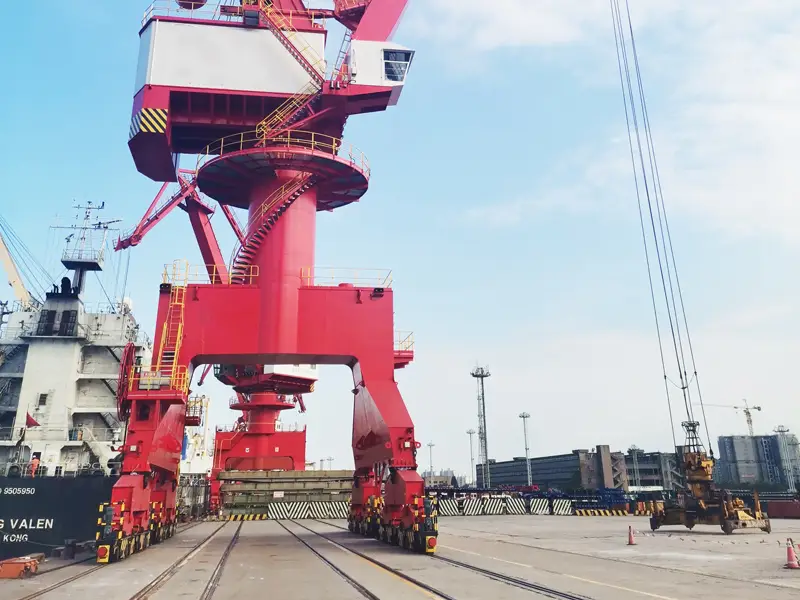
For port operators and maintenance teams, crane rail wear is a constant challenge. Frequent rail replacement not only increases labor and material costs but also disrupts loading operations and reduces overall efficiency.
In one case, Company A operated multiple quay cranes under long-term heavy loads. Severe rail wear and repeated rail fractures led to equipment damage and unstable operations. This raises a key question: why does rail wear occur much faster in port environments than in workshops or warehouses?
This article breaks down the real causes based on port working conditions, helping you identify the root issues and reduce long-term wear.
1. Primary Causes of Crane Rail Wear in Ports
Heavy Loads and High-Frequency Operation
Ports handle continuous cargo movement, and cranes often run close to 24/7. With increasing throughput, crane utilization rates remain high year-round.
The combination of crane self-weight and cargo loads puts constant pressure on the rails, especially when standard rails are used instead of heavy-duty crane rails. At the same time, frequent starting and braking introduce repeated impact loads. Similar to how frequent braking wears out tires, every crane movement adds stress to the rail surface.
Over time, this leads to surface wear, indentation, and even cracking. In many ports, cranes also operate beyond rated loads to improve efficiency, which further accelerates crane rail wear. In Company A’s case, long-term overloading caused rail clips to loosen and steel pads to deform, eventually leading to rail damage.
Misalignment and Wheel Flange Contact (Crane Rail Wear Acceleration)
Misalignment is a hidden but critical factor behind crane rail wear. When crane wheels are not properly aligned with the rails, wheel flanges rub against the rail sides, causing side wear and uneven stress distribution.
This issue becomes more severe in high-speed trolley movement, especially near hinge points where vibration intensifies. Combined with flange contact and lateral forces, the rail experiences both vertical and horizontal wear.
This “double impact” significantly accelerates rail wear, often resulting in visible step wear within a short period.
Harsh Port Environment and Rail Corrosion
Most ports sit near the sea or along rivers. These environments speed up rail wear from both inside and outside factors.
First, salt air and moisture cause the rail surface to rust. Rust weakens the steel and makes the surface rough. This increases friction between the wheel and the rail. Areas like rail joints and fastening points face higher risk. Water and dust often collect there, which makes corrosion worse. Over time, this can reduce the rail’s strength and create safety risks.
Second, port operations create dust, sand, and small debris. These particles stay on the rail or get into gaps. They act like grinding material. When crane wheels run over them, they wear down the rail surface faster. This not only increases crane rail wear, but can also cause blockage or misalignment.
2. Secondary Causes That Increase Crane Rail Wear
Poor Installation Accuracy
The quality of rail installation impacts long-term performance. If alignment, level, or gauge isn’t properly controlled, cranes can move unevenly, adding extra lateral forces to the rail.
Misaligned joints or uneven rail heights create impact loads when wheels pass over them. This accelerates localized crane rail wear over time.
Lack of Proper Maintenance
In many ports, heavy operation is prioritized over maintenance. Small issues such as dust accumulation, insufficient lubrication, or loose fasteners are often ignored.
Over time, these minor problems develop into serious wear issues. Loose clips, uncleaned surfaces, and lack of rust removal all contribute to increased friction and faster degradation.
Incorrect Rail Material Selection
Rail material plays a key role in wear resistance. Rails with insufficient hardness or strength cannot withstand high loads and repeated impacts.
In some cases, mismatched hardness between wheels and rails leads to excessive rail wear. Company A improved performance by switching to higher-strength rail material with increased surface hardness, significantly reducing crane rail wear.
3. The Hidden Impact of Excessive Crane Rail Wear
Crane rail wear is not just a surface issue—it can lead to serious operational and safety risks:
- Safety risks: Severe wear may cause rail fracture or misalignment, increasing the risk of derailment and equipment damage.
- Operational losses: Rail replacement requires downtime, directly affecting port throughput and efficiency.
- Equipment damage: Increased wear on rails also accelerates damage to wheels, bearings, and other components.
4. How to Reduce Rail Wear in Port Applications
Crane rail wear in ports is the result of combined factors: heavy loads, high-frequency operation, misalignment, harsh environments, and maintenance gaps.
To reduce wear and extend service life, it is essential to:
- Use high-strength, wear-resistant rail materials
- Ensure precise installation and alignment
- Perform regular inspection and maintenance
- Address misalignment and vibration issues early
Choosing the right crane rail system and material can significantly reduce maintenance costs and improve long-term operational stability.