
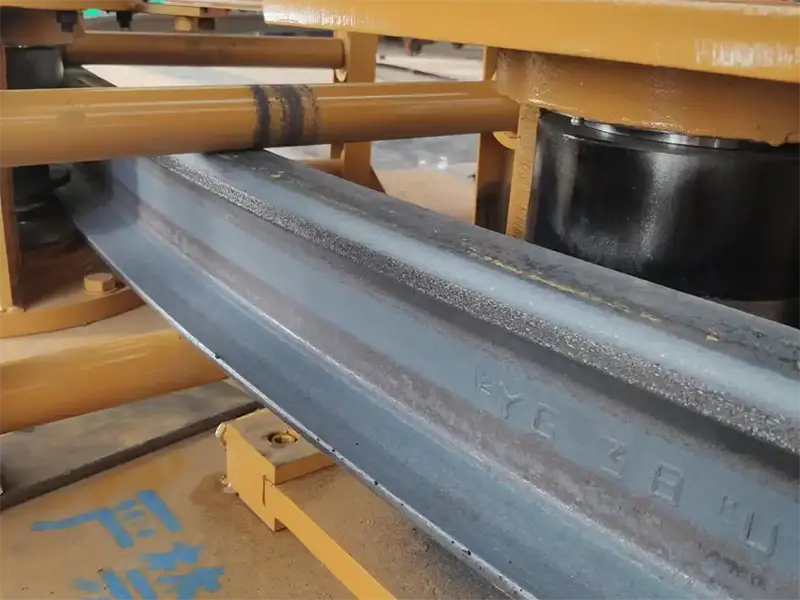
In railroad construction, turnout production, and track maintenance, rail bending is a crucial procedure. In order to fit the intended alignment of railway lines, straight rails frequently need to be bent, particularly in curve portions, switch locations, and intricate track layouts.
Modern rail engineering mainly uses two types of rail forming processes: cold and hot rail bending. These two methods differ significantly in processing temperature, forming capability, material behavior, precision, and production cost. Selecting the appropriate rail bending method plays an important role in ensuring track geometry accuracy and long-term operational safety.
This article explains the principles, advantages, and applications of the two most common rail bending methods used in railway infrastructure projects.
What Is Rail Bending?
Rail bending is the process of shaping straight railway rails into a designed curvature to meet the geometric requirements of a railway line. The process is widely used in:
- railway curve sections
- turnout and switch areas
- metro and light rail systems
- industrial rail tracks
- mining railways
Modern rail bending machines apply controlled mechanical force to gradually deform the rail while maintaining structural integrity and dimensional accuracy.
Depending on whether the rail is heated during processing, rail bending can be classified into cold bending and hot bending.
Cold Rail Bending Process
Cold rail bending is carried out at room temperature, below the steel’s recrystallization point. A specialized bending machine applies controlled force to gradually shape the rail to the desired curve.
This method takes advantage of steel’s natural plasticity at ambient temperature. Once the applied stress exceeds the rail’s yield strength, it permanently deforms while maintaining its original metallurgical structure.
Modern cold bending machines use computer-controlled systems to precisely adjust force, speed, and curvature. This ensures highly accurate bends with minimal deviation, even for tight curves or precision-critical applications.
Advantages of Cold Rail Bending
Cold rail bending offers several technical advantages:
- High bending precision, suitable for strict geometric requirements
- No change in metallurgical structure, preserving the original material properties
- Smooth surface quality without oxidation or scale
- Lower energy consumption compared with heated processes
- Shorter processing cycle, enabling higher production efficiency
Because of these advantages, cold bending is widely used in urban rail transit systems, high-speed railways, and turnout sections, where rail alignment accuracy is extremely important.
Limitations of Cold Bending
Despite its benefits, cold bending also has certain limitations. The process requires rails with sufficient toughness, since brittle or high-carbon materials may crack during deformation. In addition, plastic deformation can introduce residual internal stresses, which may require stress-relief treatment after bending.
Hot Rail Bending Process
Hot rail bending involves heating the rail to a high temperature before shaping. Typically, the rail is heated to an austenitizing temperature range of approximately 900°C to 1100°C, which significantly reduces the material’s yield strength and increases its plasticity.
Once the rail reaches the required temperature, rail bending equipment is used to form the desired curvature. After shaping, the rail is cooled and may undergo heat treatments such as normalizing or tempering to restore its mechanical properties.
In many modern workshops, medium-frequency induction heating is used to ensure uniform temperature distribution along the rail section. This helps prevent local overheating and protects the base material from structural damage.
Advantages of Hot Rail Bending
Hot bending provides several important benefits:
- Greater forming capability for large deformation or thick rails
- Reduced risk of cracking during bending
- Suitable for high-strength or alloy rails
- Better adaptability for complex curves and heavy-duty rail systems
Because the material becomes softer at high temperature, much less mechanical force is required to achieve the desired shape.
Limitations of Hot Bending
However, hot bending also involves several disadvantages. The process requires heating equipment, heat treatment facilities, and additional process steps, which increases energy consumption and production cost.
High-temperature processing may also produce oxidation scale on the rail surface, which may require additional finishing operations such as grinding or shot blasting. In addition, thermal expansion and contraction can make dimensional accuracy more difficult to control compared with cold bending.
Cold Bending vs Hot Bending: Key Differences
The two rail bending processes differ in several technical aspects. The table below summarizes their main characteristics.
| Factor | Cold Bending | Hot Bending |
|---|---|---|
| Processing temperature | Room temperature | 900–1100°C |
| Metallurgical structure | No structural change | Austenite transformation occurs |
| Bending precision | Very high | Moderate |
| Surface condition | Smooth surface | Oxide scale may appear |
| Forming capability | Limited by material toughness | Suitable for large deformation |
| Energy consumption | Low | High |
| Production efficiency | High | Lower due to heating and cooling |
Both processes have unique advantages and are used in different engineering situations.
Choosing the Right Bending Process
Selecting the appropriate rail bending method depends on several engineering factors, including:
- rail material and hardness
- required curve radius
- dimensional accuracy requirements
- project cost considerations
- available processing equipment
In many cases, engineers evaluate these parameters carefully before choosing between cold and hot rail bending. Proper process selection ensures both structural reliability and long-term railway safety.
Rail Processing Solutions from Glory Track
As a professional rail supplier, Glory Track provides comprehensive rail processing and fabrication services for railway and industrial rail systems. These services include rail cutting, drilling, machining, and rail bending tailored to specific project requirements.
With modern production facilities and extensive experience in rail manufacturing, Glory Track supports customized rail solutions for infrastructure projects, port crane systems, mining railways, and industrial track applications.
If you are looking for reliable rail products or customized rail processing services, the team at Glory Track can help provide the right solution for your project.