
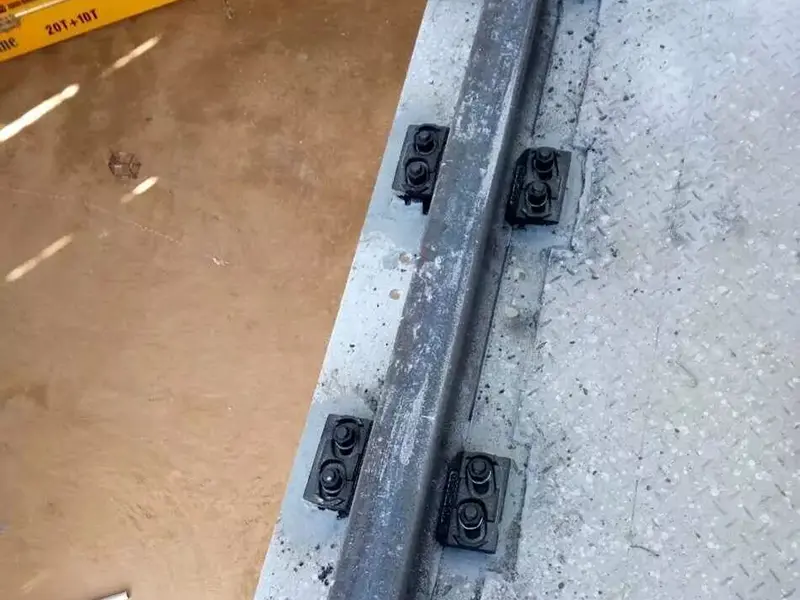
In modern heavy-duty material handling systems, the stability of a crane runway does not depend only on the crane itself. It also depends on how loads are transferred through the rail structure. This is why crane rail load analysis is essential in system design.
Accurate crane rail load analysis is essential. It helps ensure safe operation, control rail deformation, and prevent fastening failure. This is especially important for high-capacity cranes used in ports, steel plants, shipyards, and large industrial facilities.
As crane capacities continue to increase and working conditions become more complex, understanding how forces act on the rail has become a basic requirement in system design.
1. Introduction: Why Crane Rail Load Analysis Matters
Crane rails are the direct interface between moving equipment and structural support systems. Every load generated by the crane is transferred through wheels onto the rail, and then distributed into the supporting beams and foundation.
In real-world applications, failures are rarely caused by a single overload event. Instead, they are the result of accumulated stresses from:
- Repeated dynamic loading
- Uneven track settlement
- Wind exposure in outdoor environments
- Improper rail fastening selection
This is why crane rail load analysis plays a key role in both design and maintenance planning.
2. Vertical Load on Crane Rails
The vertical load is the primary force acting on the rail system. It is generated by:
- Crane self-weight
- Trolley system weight
- Rated lifting load
- Dynamic impact during lifting and braking
Under ideal conditions, the maximum wheel load represents the peak vertical force transmitted to the rail.
However, in real engineering environments, conditions are rarely ideal. Structural settlement, installation deviation, or uneven beam deflection can significantly alter how vertical loads are distributed along the rail.
Over time, this can lead to localized stress concentration, increasing the risk of rail deformation and fastening fatigue.
3. Longitudinal Forces Along Crane Rails
Longitudinal forces act in the direction of crane travel and are one of the most critical aspects in crane rail load analysis.
These forces are typically composed of four main components:
Rolling Resistance
This is always present during crane movement and results from wheel-rail contact deformation. It is commonly estimated using a rolling friction coefficient between 0.02 and 0.04, depending on rail condition and operating environment.
Wind Load (Outdoor Cranes)
For gantry cranes, shipyard cranes, and port equipment, wind load becomes a significant factor. Wind pressure acting on large structural surfaces can create continuous longitudinal resistance, especially under high wind exposure.
Acceleration and Braking Forces
During startup and stopping phases, cranes experience inertia forces proportional to total system weight and travel speed. These transient forces often create peak stress conditions on the rail fastening system.
Track Irregularity Effects
Uneven rail elevation or structural settlement introduces additional gravitational components along the travel direction, further increasing longitudinal force demand.
Together, these forces define the total longitudinal load acting on the rail system, which directly influences rail creep, fastener performance, and overall track stability.
4. Lateral Forces on Crane Rail Systems
Lateral forces are often underestimated but play a crucial role in rail alignment and long-term system reliability.
They are mainly caused by:
- Wheel misalignment during travel
- Trolley side movement
- Uneven rail installation
- Wind load acting on crane structure
In heavy-duty applications, lateral forces can lead to rail side shifting, flange wear, and long-term misalignment if the fastening system is not properly designed.
A simplified representation of lateral force includes rolling resistance, wind load components, acceleration effects, and uneven structural conditions.
This is why modern crane rail systems require fastening solutions that can resist both vertical pressure and horizontal displacement simultaneously.
5. Combined Load Behavior in Real Engineering Conditions
In practical applications, crane rail systems do not experience isolated forces. Instead, vertical, longitudinal, and lateral forces act simultaneously and continuously fluctuate during operation.
The interaction of these forces is influenced by:
- Crane working duty class
- Span length of crane girders
- Environmental conditions (wind, temperature variation)
- Installation accuracy
- Rail support stiffness
As span increases, both dynamic amplification and structural deflection become more significant, increasing overall load complexity.
This makes simplified static design insufficient for modern high-performance crane systems.
6. Importance of Rail Fastening Systems in Load Resistance
A critical outcome of crane rail load analysis is the selection of an appropriate rail fastening system.
Rail fasteners are not only responsible for holding the rail in place but also for resisting multi-directional forces generated during crane operation.
An effective fastening system should:
- Prevent rail sliding under longitudinal force
- Resist lateral displacement under side loads
- Maintain clamping force under vibration and fatigue
- Adapt to dynamic load variations
In heavy industrial environments, advanced rail clips with self-locking and anti-loosening mechanisms are increasingly preferred over traditional fixed plate systems.
7. Engineering Insight: Why Traditional Rail Fixing Systems Fail
Many conventional rail fastening solutions fail under long-term operation due to:
- Insufficient clamping force
- Lack of anti-slip design
- Poor fatigue resistance
- Inability to handle dynamic load changes
This leads to rail movement, misalignment, and increased maintenance frequency.
Modern systems used in ports, steel mills, and mining operations increasingly require positive locking rail clips that provide controlled force distribution and stability under complex loading conditions.
8. Conclusion
A comprehensive crane rail load analysis is essential for ensuring safe, stable, and efficient crane operation in demanding industrial environments.
By understanding vertical, longitudinal, and lateral forces, engineers can make better decisions in rail design, structural support selection, and fastening system configuration.
As global crane systems continue to scale in size and capacity, the importance of accurate rail load analysis and high-performance fastening solutions will only continue to increase.