
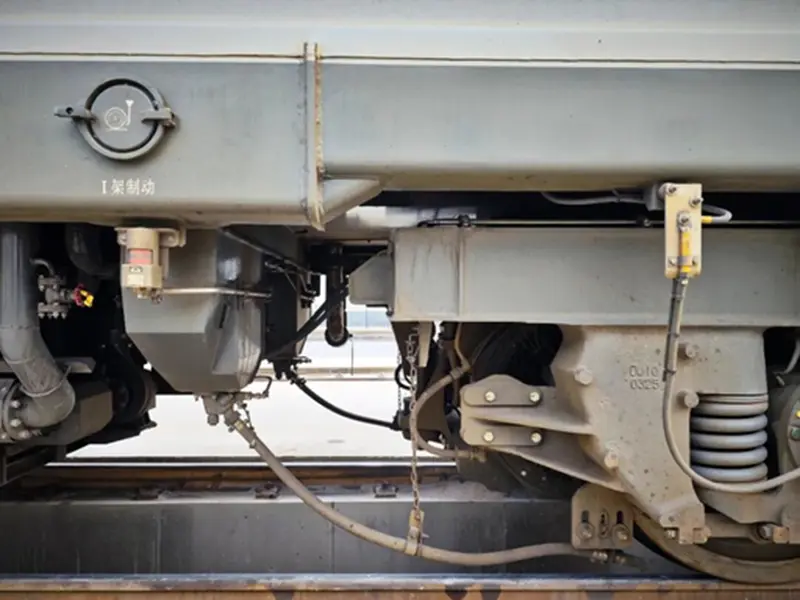
A train sanding system works by placing sand directly onto the rail surface, which helps boost traction and stop wheels from slipping during travel. This function is especially vital when wheel-rail adhesion is low, such as in rainy or icy conditions, when the rails are contaminated with oil, or when the train is operating under heavy loads.
In actual railway operations, keeping consistent and stable contact between wheels and rails can be difficult. Even during regular service, the level of adhesion may change unexpectedly. For these reasons, sanding is widely regarded as a practical and dependable solution, rather than merely a supplementary device.
What Causes Wheel Slip in Railway Operations?
Wheel slip happens when the available adhesion between the wheel and rail is not enough to support traction or braking forces. In industrial rail systems such as crane rails, poor wheel-rail interaction can also lead to more serious issues beyond slipping, including misalignment and derailment problems.
In practice, this issue shows up more often than expected—particularly in outdoor rail systems where environmental factors constantly affect the track surface.
Wheel Spin During Traction
When a train starts, accelerates, or climbs a gradient, insufficient adhesion may cause the wheels to spin without effectively moving the train forward.
This is commonly seen in:
- Wet or oily rails
- Leaf-contaminated tracks
- Heavy-haul railway conditions
In these situations, a train sanding system helps restore traction quickly and keeps operations stable.
Wheel Slide During Braking
During braking, especially in emergency or low-adhesion scenarios, wheels may lock and slide instead of rolling.
From an operational standpoint, this can:
- Increase stopping distance
- Reduce braking efficiency
- Create safety risks in critical zones
This is another case where a train sanding system plays a direct role in maintaining control.
Impact on Rail and Wheel Components
Uncontrolled wheel slip—whether spin or slide—can lead to long-term damage, including:
- Wheel flats
- Rail surface wear
- Increased maintenance frequency
How Does a Train Sanding System Work?
A train sanding system delivers dry sand onto the rail, typically just ahead of the wheel contact point.
Although the principle is simple, the effect is significant.
In real conditions, sanding:
- Breaks through water, ice, or oil films
- Increases surface roughness
- Improves grip between wheel and rail
Compared to untreated rail contact, the improvement in adhesion is immediately noticeable, especially under load.
What Are the Key Functions of a Train Sanding System?
Rather than seeing it as just “adding sand,” it’s more accurate to treat it as a traction control mechanism within railway systems.
Improve Traction
A train sanding system allows the locomotive to transfer power more efficiently, especially during startup and uphill movement.
Prevent Wheel Slip
By increasing friction at the contact point, it helps reduce both wheel spin and sliding.
Enhance Braking Performance
Better adhesion leads to shorter and more predictable stopping distances.
Reduce Wear on Rail and Wheels
By limiting uncontrolled slip, sanding contributes to longer service life of key components.
What Components Are Included in a Train Sanding System?
Modern train sanding systems are designed for reliability and often operate automatically.
They typically include:
Sand Box
Stores dry sand and prevents moisture-related issues.
Sanding Valves and Nozzles
Control sand flow and ensure accurate placement on the rail.
Piping System
Transfers sand using air pressure or gravity.
Control System
In many cases, the system activates automatically when wheel slip is detected, providing immediate response without manual input.
What Type of Sand Is Used in a Train Sanding System?
The effectiveness of a train sanding system depends heavily on the quality of sand used.
Typical requirements include:
- High-purity quartz material
- Controlled particle size (around 1–3 mm)
- Completely dry and clean condition
Poor-quality sand can reduce performance or even block the system, which is why material selection matters.
Where Is a Train Sanding System Most Important?
A train sanding system is used in almost all railway applications, but its importance becomes more obvious in demanding conditions:
- Heavy-haul railways
- Mining rail systems
- Steep gradient routes
- Wet or cold environments
In these scenarios, sanding is often essential for maintaining operational reliability.
Why Is the Train Sanding System So Important?
Although it may seem like a simple system, its impact on railway safety is significant.
In many cases, a train sanding system is the difference between stable operation and loss of control under low-adhesion conditions.
It provides:
- Better traction control
- More reliable braking
- Reduced mechanical wear
- Increased operational safety
Conclusion
The train sanding system is a straightforward yet highly effective solution to wheel slip in railway operations.
By improving traction and stabilizing braking performance, it continues to play a critical role in both conventional and heavy-duty rail systems.