
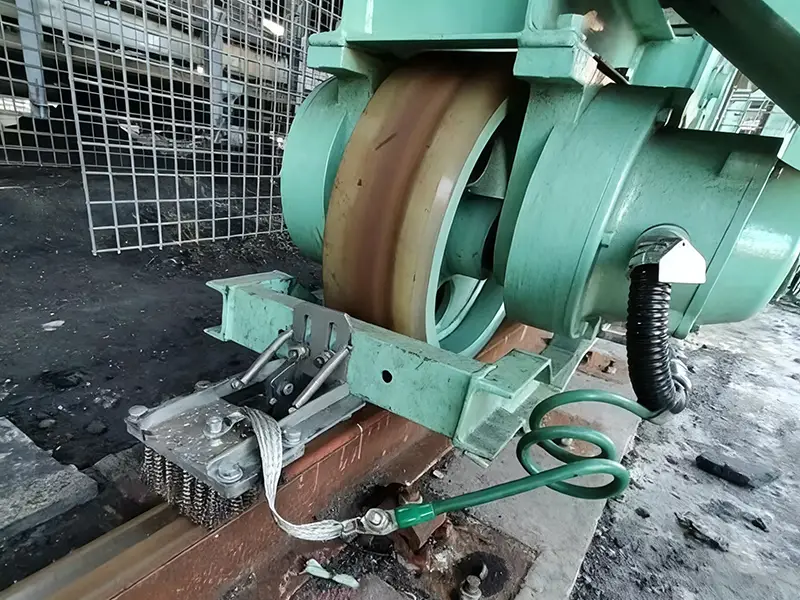
Project Background
A crane rail cleaning system plays a critical role in maintaining travel stability, wheel performance, and operational safety in heavy-duty crane operations.
In real industrial environments, crane rails are continuously exposed to contamination generated by material handling processes and surrounding working conditions. Over time, fine particles, moisture, and process residues accumulate on the rail surface and gradually change the wheel–rail contact behavior.
This change is not always visible in the early stage. However, it directly affects the friction condition between the crane wheel and rail head, especially under wet, cold, or high-frequency operating conditions.
In port bulk handling systems, fine dust from animal feed or plant-based pellets accumulates along the rail. When exposed to rainwater, these materials absorb moisture and form a semi-sticky layer on the rail surface, reducing surface friction and affecting trolley movement stability.
In recycling plant applications, shredded plastic particles combine with condensation moisture. During winter periods, this mixture can partially freeze on the rail surface, creating localized low-friction zones.
In mining shuttle systems, crane operation is continuous and bidirectional. Rail cleaning is often not synchronized with operating cycles, leading to gradual contamination buildup along the entire travel path.
Across all applications, the same operational behavior is observed: rail surface condition deteriorates progressively under real working environments, leading to unstable wheel–rail interaction.
Operational Issues Observed in Field Applications
Based on recent project inquiries and field feedback, three representative operational conditions were identified:
In port crane systems, rail contamination is mainly caused by fine organic dust from bulk materials. Under rainfall conditions, this dust absorbs moisture and forms a compact layer on the rail surface. Once this layer is formed, the wheel–rail friction coefficient decreases significantly, and intermittent trolley sticking begins to occur during travel.
In recycling plant crane systems, shredded plastic residues accumulate on the rail surface and mix with condensed moisture. Under low-temperature conditions, partial freezing occurs. This leads to irregular surface texture along the rail head and increases the risk of wheel slipping during acceleration or deceleration phases.
In mining shuttle rail systems, equipment operates under high-frequency back-and-forth movement. Due to the lack of dedicated cleaning intervals, dust accumulation becomes continuous. The contamination does not remain uniform, which results in uneven friction conditions along different rail sections.
Although the sources of contamination differ, the failure mode remains consistent: reduced traction stability caused by surface contamination on crane rails.
Core Requirements for Rail Cleaning System
To address the above operational conditions, a crane rail cleaning system must meet the following requirements:
- Multi-type contamination removal capability
The system must handle dry dust, wet residues, plastic fragments, and frozen surface layers without performance degradation. - Stable rail friction restoration
The cleaned rail surface must maintain sufficient friction conditions to support stable wheel–rail contact and prevent slipping. - Environmental adaptability
The system must operate reliably under coastal humidity, freezing temperatures, and mining dust environments with continuous exposure. - Compatibility with rail systems
The system must be adaptable to different rail profiles, including DIN 536 crane rails, AS series rails, and other heavy-duty rail types. - Bi-directional operation capability
For shuttle crane systems, the cleaning function must remain effective in both travel directions and support symmetrical installation.
Customized Crane Rail Cleaning Solutions
To address different contamination mechanisms and working environments, GloryTrack provides modular rail cleaning systems:
- Steel wire brush cleaning system
Designed for dry dust, bulk material residues, and port environments. The brush maintains continuous contact with the rail surface during crane travel and removes fine particles effectively. - Scraper-based cleaning system
Designed for ice, frozen moisture, and sticky residues. Polyurethane scraper elements remove bonded contamination while minimizing wear on the rail head. - Combined brush + scraper system
Designed for mixed contamination conditions where dust, moisture, and residues coexist. The system provides staged cleaning to restore rail surface friction conditions. - Bi-directional rail cleaning configuration
Designed for mining shuttle systems and continuous operation environments. Installed on both sides of the rail to ensure consistent cleaning during forward and reverse movement.
All systems are designed with adjustable mounting structures to fit different crane rail profiles and operational layouts.
Project Performance and Operational Results
After implementation in real operating environments, the crane rail cleaning systems demonstrated stable performance across different industrial applications.
Wheel slipping incidents were significantly reduced in port and recycling environments where wet and frozen contamination previously affected rail conditions. Crane travel stability improved, especially during acceleration and deceleration phases.
In mining shuttle systems, continuous rail cleaning helped maintain more consistent surface conditions along the travel path, reducing uneven friction zones caused by dust accumulation.
Overall, the system improved rail surface stability, reduced wheel–rail wear progression, and enhanced operational reliability in continuous-duty crane applications.
Why Glory Track
GloryTrack focuses on crane rail system engineering and heavy-duty rail application solutions for industrial environments where rail surface condition directly impacts operational safety and equipment performance.
Our solutions are widely applied in port handling systems, mining shuttle operations, recycling facilities, and other heavy-duty environments requiring continuous rail operation.
We provide application-oriented engineering solutions rather than standalone components, ensuring performance reliability under real working conditions.
Contact Us
If your crane system is experiencing rail contamination, wheel slipping, or unstable travel performance, contact us to discuss a tailored crane rail cleaning solution for your application.