
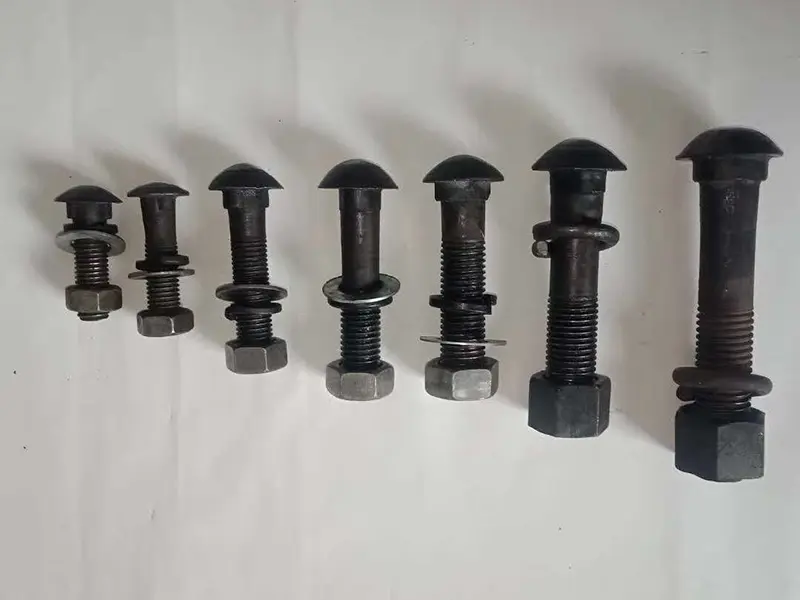
What Are Fish Bolts?
Fish bolts, alternatively referred to as fishplate bolts, are custom fasteners engineered for rail joint connection. Paired with fishplates, also known as joint bars, they secure adjacent rail ends in precise alignment and ensure long-term railway track stability.
Differing from ordinary standard bolts, this type of fastener is purpose-built to withstand harsh railway operating conditions. It is structurally optimized to endure continuous vibration, heavy static and dynamic loads, as well as long-cycle alternating stress, setting it apart from conventional hexagon head bolts in overall design and mechanical performance.
Fish Bolts vs Hex Bolts: What’s the Real Difference?
At first glance, a standard hex bolt may seem like a simple substitute. In reality, the difference becomes obvious during installation and long-term operation.
Hex bolts:
- Require access from both sides during tightening
- Tend to rotate if the head is not held in place
- Not designed for confined rail joint spaces
- Less stable under vibration
Fish bolts (oval neck design):
- Allow single-side installation
- Prevent rotation automatically
- Fit precisely into fishplate slots
- Provide more reliable long-term fastening
In railway applications, these differences are not minor. They directly affect installation efficiency and track safety.
Why Oval Neck Design Is Essential
The oval neck is the defining feature of fish bolts. It is not just a shape choice. It solves several real problems in rail joint installation.
- Prevents Bolt Rotation
In a rail joint, space is limited. When tightening a nut, a standard bolt may rotate along with it. This makes proper tightening difficult.
The oval neck fits into the matching slot of the fishplate. Once inserted, it locks in place. This allows workers to tighten the nut from one side only, without holding the bolt head.
- Works in Confined Spaces
The inner side of a rail joint is narrow and hard to access. Using tools on both sides is often impractical.
With fish bolts, installation becomes much simpler. Workers insert the bolt, tap it into position, and tighten from the outside. This saves time and reduces labor difficulty, especially in field conditions.
- Improves Load Distribution
The oval head provides a larger contact area compared to standard bolt heads. This helps distribute the clamping force more evenly across the fishplate.
Better load distribution reduces:
- Local stress concentration
- Risk of deformation
- Loosening under dynamic loads
This is critical for maintaining long-term track stability.
- Easy Identification in Maintenance
Railway environments are often low-light or high-pressure during repairs. The unique shape of fish bolts makes them easy to identify by sight or even by touch.
This helps maintenance teams work faster and avoid installation errors.
Can Hex Bolts Be Used as a Substitute?
In urgent situations, hex bolts can be used as a temporary replacement. However, there are strict conditions.
- Use only high-strength bolts (Grade 8.8 or above)
- Ensure proper anti-rotation measures
- Plan for replacement with proper fish bolts as soon as possible
Hex bolts are not designed for rail joint systems. Long-term use can lead to loosening, misalignment, or maintenance issues.
How to Choose the Right Fish Bolts for Rail Joints
When selecting fish bolts, consider the following:
- Rail type and joint configuration
- Bolt strength grade and material
- Compatibility with fishplate design
- Corrosion protection requirements
- Project environment (railway, crane rail, mining, etc.)
Using the correct rail joint bolts ensures both safety and durability.
Why Work with Glory Track?
At Glory Track, we provide reliable fish bolts and complete rail fastening solutions for railway, crane, and industrial applications, backed by over 15 years of industry experience and consistent quality under ISO 9001 standards. Whether you need standard or custom fishplate bolts, we focus on delivering practical performance in real working conditions. If you are looking for a dependable supplier, feel free to contact us to discuss your project or request a quote.