

Fish plates, also known as rail joint bars, connect rail ends. They are easier to install and need less maintenance than welded rail joints. These bars are usually fixed with fish bolts to ensure tight rail – end connections. The holes in the middle of the fishplate help it hold the rail ends firmly. They also let the fishplate resist the up – down, side – to – side, and lengthwise forces on the rails.
Fish Plates for Different Rail Types: Light, Heavy & Crane Rails
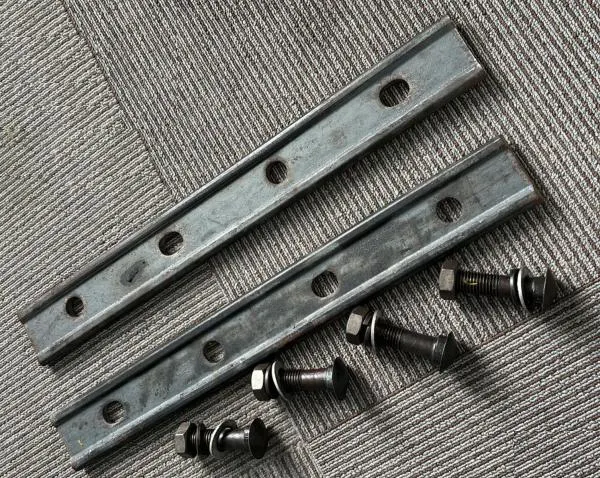
Light Rail Fishplates: Designed for light rails such as 8kg, 9kg, and 12kg rails. These fishplates have four bolt holes. As a result, they are lighter and smaller compared to heavy rail fishplates. They are commonly used in small factory rails, simple mining rails, and other low-load applications.
Heavy Rail Fishplates: These are used for heavy-duty railway tracks, including 38kg, 43kg, and 50kg rails. Typically, they have six bolt holes, ensuring a more secure connection. They are ideal for railway systems and large-scale logistics hubs where high stability is required.
Crane Rail Fishplates: Designed for crane rails with specific cross-sections. These fishplates are commonly used in industrial plants, large ports and heavy industrial facilities.
Materials
Ductile Iron Fishplates: High strength and good toughness, suitable for heavy-duty railways. It can efficiently spread out the stress, endure the repeated heavy pressure and strong jolts from the train, and is not prone to deformation and breakage.
Rolled Q235 Steel Fishplates: Made from Q235 steel, offering good strength and wear resistance. These fishplates are widely used in branch railways, local railways, and cost-sensitive rail projects, providing durability against wear and pressure from train operations.
Forged Fishplates: Manufactured through forging, these fishplates have high strength and precision. They are used in high-speed railway connections and precision instrument transport rails, ensuring a seamless connection.
Alloy Steel Fishplates: Made from alloy steel to meet specific environmental requirements. They are ideal for high-temperature, extremely cold, or chemically corrosive environments such as mining tracks and chemical plant rail systems.
Stainless Steel Fishplates: Highly corrosion-resistant, suitable for seaside railways, chemical plants, and other harsh environments. These fishplates resist seawater and chemical corrosion, extending their service life.
Specific Applications
Standard Fishplates: Commonly used in general railway applications, ensuring stable rail connections.
Special-shaped Rail Joint Bars: Used to connect rails of different sizes, such as 50/60kg or 43/50kg rails. These fishplates are essential for railway upgrades, ensuring smooth transitions between different rail types.
Bulged Fish plates: Designed for seamless welded rail joints, featuring a unique bulged shape to enhance stability at weld joints.

Vibration-Damping Fishplates: Commonly used in urban transit systems and railways with strict noise control requirements. These fishplates reduce vibrations and noise, improving passenger comfort.
Bonded Fishplates: Connected to rails through adhesive bonding, enhancing joint integrity and reducing maintenance frequency. They are used in tracks requiring high stability.
Frozen Joint Fish plates: Designed to secure rail joints and minimize movement or deformation, ensuring stability in high-speed rail applications.
Transition Joint Bars: Used in track curves or areas with rail transitions, such as urban transit curves and railway turnouts, ensuring smooth train passage.
Insulated vs. Non-Insulated Rail Joint Bars
Insulated Fish plates: Made from insulating materials to prevent electrical conductivity. These are essential in railways with signaling systems or electrified tracks, such as subways and electric railways, preventing electrical interference.
Non-Insulated Fish plates: Used in standard track applications where insulation is not required. They are widely used in conventional railways and factory rail systems.
How to Select and Maintain Fish Plates?
When selecting fish plates, factors such as rail type, operating environment, and load requirements must be considered. For heavy-duty railways, ductile iron or alloy steel fishplates are recommended. In corrosive environments such as coastal areas, stainless steel fishplates provide the best durability. Electrified railways need insulated fishplates to prevent electrical interference.
The maintenance of fishplate is also important. Regularly check the tightness of bolts and retighten them if necessary. Inspect fish plates for cracks, wear, or damage, and replace them as needed. For the fishplate used in special environments, to strengthen the protective measures, such as the stainless steel fishplate for regular cleaning to prevent corrosion adherence.
Choosing the right fish plate is essential for rail safety and stability. Different rail types and environments need specific fishplate materials and designs. Glory Track is a professional supplier of railway accessories. We provide fishplates for light rail, heavy rail, and crane rail. Moreover, we can also offer customized fishplates according to customers’ requirements to meet the needs of different projects, such as those in railways, mining rails, urban transit systems, and port project. These customized fishplates ensure secure rail connections and enhance track durability.
Whether you need standard or customized fishplates, GloryTrack provides high-quality solutions. Contact us for detailed specifications. Our expert team is ready to assist you with the best railway accessory solutions!