
Introduction
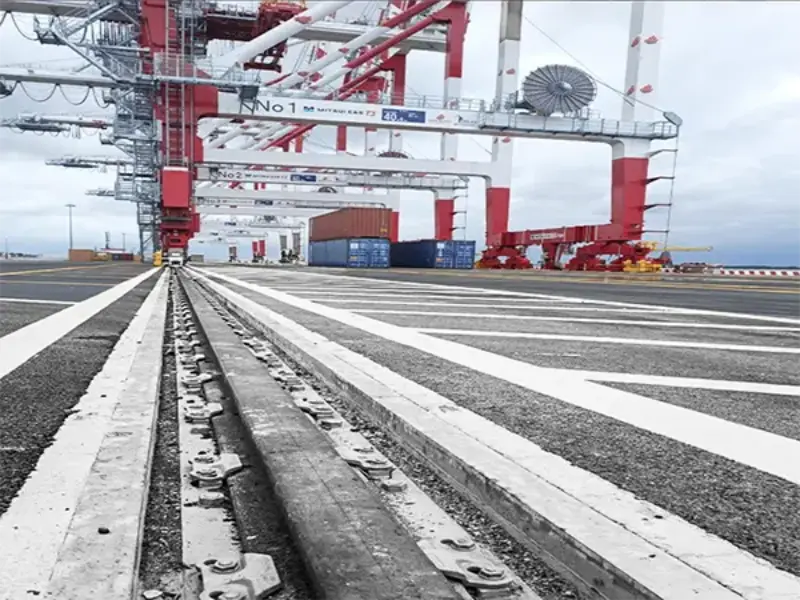
Port crane rail form the critical foundation for cargo handling operations. They provide the stable, high-strength track required for gantry cranes, ship loaders, and container handlers to move heavy loads safely and precisely. The performance, safety, and lifespan of your equipment directly depend on proper rail selection and maintenance.
This guide details the key specifications—from Gantry Crane Track to heavy-duty QU100/QU120 rails—for different crane types. We cover essential selection criteria, design considerations for harsh harbor environments, and vital maintenance practices to ensure reliable operation and maximize your system’s uptime.
Common Port Crane Types and Rail Requirements
Gantry Crane Rails
Gantry cranes cover large spans and lift heavy loads, so their rails must handle extreme structural stress and repeated cycles. QU80 or QU100/A100 or A120 heavy-duty crane rails provide the strength and stability these cranes demand. Concrete sleepers or a monolithic concrete bed support the rails and maintain alignment under constant load. Engineers leave room for thermal expansion and contraction, and designers often widen the track gauge to ≥10.5 meters for extra stability. These rails excel in multi-purpose terminals, high-traffic zones, and areas where cranes move frequently, ensuring smooth lateral motion and precise positioning across long runs.
Shore Bridge (Container) Crane Rails
Shore bridge cranes prioritize fast loading and high precision. QU100 or QU120 rails resist wear while keeping the trolley running accurately at high speed. Engineers embed rails in deep reinforced concrete foundations (≥2.5m) with anti-tidal protection. Designers also install buffer stops at track ends to prevent over-travel. These rails suit deep-water wharves, super-Panamax container operations, and high-impact loads. Smooth surfaces and precise alignment minimize downtime and protect containers, trolleys, and equipment.
Rail-Mounted Container Gantry Rails
Container yard cranes rely on high-precision rails like QU70 or QU80 with seamless welding. Prestressed concrete beams and embedded bolts secure the rails and maintain exact alignment. Integrated laser sensors or automated guide wheels allow unmanned operation. Rails cover large yard areas, support high-density container stacks (6–8 layers), and coordinate multiple cranes safely. Accuracy and straightness (≤1mm/m deviation) optimize stacking efficiency and reduce collisions.
Grab Ship Unloader / Ship Loader Rails
Grab unloaders and ship loaders face frequent, high-impact movements. QU70 or QU80 rails with high-frequency quenched and tempered surfaces (≥HB300 hardness) resist deformation and wear. Steel truss foundations with adjustable piers adapt to uneven quay conditions. Dustproof baffles and drainage troughs protect rails from bulk cargo contamination. These rails thrive in high-frequency bulk cargo operations, including coal and ore, even under soft-ground conditions.
Bridge Crane Rails
Bridge cranes operate in stable environments like port warehouses or workshops, but they require strict alignment and smooth running. QU50 or QU70 rails on plant steel beams or concrete supports provide straight, parallel paths. Anti-electromagnetic insulation prevents sparks when handling motors or sensitive equipment. These rails ensure safety, accuracy, and smooth operation in low-frequency lifting scenarios or confined indoor spaces.
Port Crane Rail Design and Maintenance Tips
Harbor environments expose rails to saltwater, wind, humidity, and temperature swings. Use corrosion-resistant or specially coated rails to prevent erosion. Include expansion joints or compensation devices to handle thermal movement. Clean tracks regularly to remove debris, dust, and standing water. Tighten loose bolts at rail joints and lubricate the rail surface to reduce wheel wear. Routine inspection ensures safe operation, extends rail life, and keeps cranes running efficiently.
Glory Track Solutions for Port Cranes
Glory Track offers a complete range of Port Crane Rail solutions. We supply rails from QU70 to QU120, including DIN, JIS, BS standards, seamless welded rails, and wear-resistant quenched rails. We provide custom accessories like anti-loosening bolts, insulating gaskets, and laser positioning bases to match different port scenarios. Our team supports layout design, installation advice, and maintenance recommendations, helping ports maximize crane performance while reducing downtime.