
R260 and R350HT UIC54 rails can be joined directly using an approved welding procedure for mixed-grade rail joints. Aluminothermic welding is a documented option. For R260-to-R350HT UIC54 joints, a published welding procedure specifies a Z90-class welding portion. Glory Track supplies Z90-equivalent aluminothermic welding kits, including the welding portion, mold, crucible, and ignition materials. Kits are available separately or bundled with UIC54 rails (54E1 profiles) for mixed-grade projects.
Although both rails share the same 54E1 profile, their different hardness and heat-treatment characteristics require careful selection of welding consumables and process parameters. The procedure must also ensure a suitable hardness distribution across the weld metal, heat-affected zone (HAZ), and parent rails. This article explains the available welding methods, consumable selection, and key quality checks for R260–R350HT UIC54 rail joints.
1. Understanding the Difference Between R260 and R350HT UIC54 Rails
A 54E1 rail has a nominal weight of 54.77 kg/m, a height of 159 mm, a base width of 140 mm, and a head width of 70 mm. Both R260 and R350HT are available for this profile.
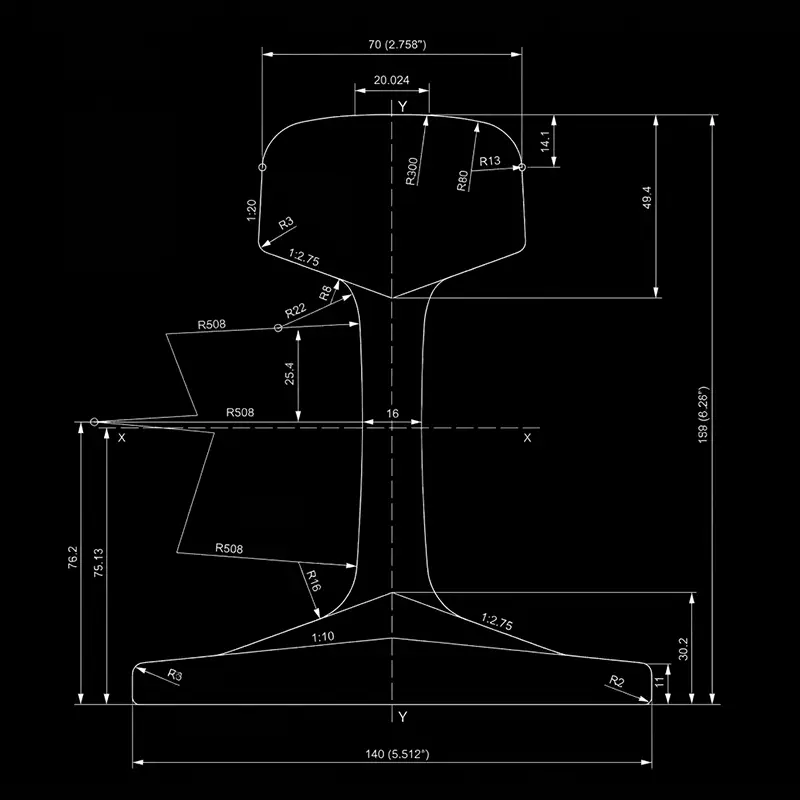
The main difference lies in their material properties and heat treatment.
| Property | R260 | R350HT |
|---|---|---|
| Steel structure | Pearlitic steel | Head-hardened pearlitic steel |
| Heat treatment | As-rolled | Head hardened |
| Typical head hardness | 260–300 HBW | 350–390 HBW |
| Main characteristic | Balanced strength and wear resistance | Higher head hardness and wear resistance |
| Common application | Conventional railway tracks | Tracks requiring improved resistance to railhead wear |
R260 rails obtain their properties through the steel composition and rolling process. R350HT rails undergo additional controlled heat treatment at the railhead to achieve higher hardness and improved resistance to wear.
This difference becomes important during welding because the heat generated around the joint can change the microstructure and hardness of both rail grades.
For this reason, welding an R260 rail to an R350HT rail requires consideration beyond simply matching their cross-sectional dimensions.
2. Can R260 and R350HT UIC54 Rails Be Welded Directly?
R260 and R350HT UIC54 rails can be joined directly without an intermediate transition rail, provided the welding procedure is approved for the mixed-grade combination and the specific rail profile.
A published aluminothermic welding procedure specifically covers R260-to-R350HT joints and specifies a Z90 welding portion for this combination.
The procedure lists the following welding portion selections:
| Rail Grade Combination | Specified Welding Portion |
|---|---|
| R260–R260 | Z90 |
| R350HT–R350HT | Z110 |
| R260–R350HT | Z90 |
For mixed-grade joints, the welding portion is selected according to the lower-hardness rail rather than automatically using the portion specified for the harder grade.
This distinction is important. Although R260 and R350HT share the same rail profile, their different material properties require careful selection of welding consumables. Using the welding portion specified for an R350HT-to-R350HT joint should not be assumed suitable for an R260-to-R350HT connection.
The Z90 recommendation applies to the specific welding system and procedure documented in the reference. It should not be treated as a universal selection rule for all aluminothermic welding systems.
Before welding 54E1 (UIC54) rails, confirm that the selected welding portion, mould, rail-end gap, preheating conditions, and approved procedure are suitable for the actual rail profile and mixed-grade combination.
3. Which Welding Methods Can Be Used for R260–R350HT Rail Joints?
Two established methods are relevant to rail welding: aluminothermic welding and flash butt welding.
Their suitability for mixed-grade connections depends on the approved procedure and the requirements of the railway authority.
3.1 Aluminothermic Welding
Aluminothermic welding is the most directly documented method identified for R260-to-R350HT rail connections.
It uses an exothermic chemical reaction to produce molten steel, which is poured into a mould surrounding the prepared rail ends. After solidification, the excess weld metal is removed and the joint is finished by grinding.
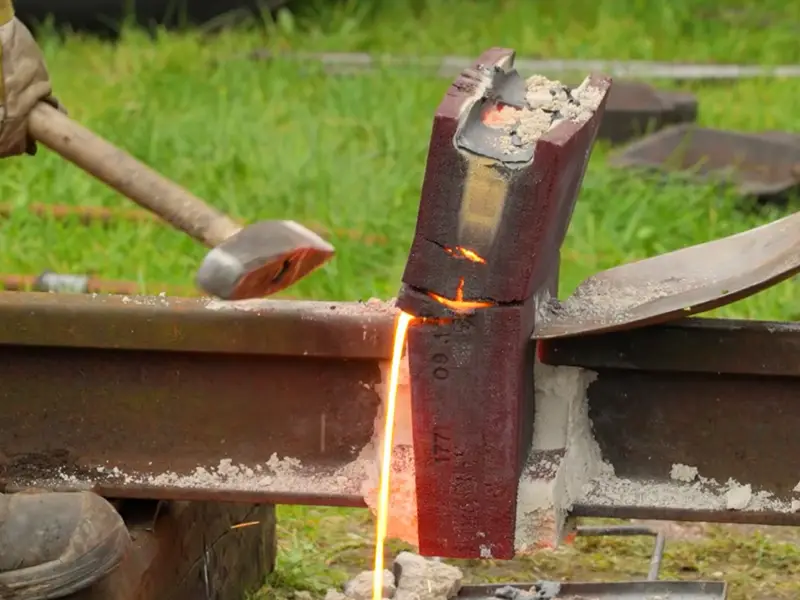
The process is particularly useful for on-site rail joining and track maintenance because it does not require a large stationary welding machine.
For R260–R350HT joints, the welding portion must be selected according to the specific combination rather than the grade of either rail alone.
This shows why a welding kit designed for one rail grade should not automatically be assumed suitable for another combination.
Before selecting a welding kit, confirm: The welding portion, mould, preheating conditions, and other process parameters must follow the approved procedure for the specific rail profile and grade combination.
3.2 Flash Butt Welding
Flash butt welding is another established method used to join railway rails.
The process brings the rail ends together under electrical current. Resistance heating generates sufficient heat at the contact surfaces, followed by controlled upsetting to form a solid-state welded joint.
Both R260 and R350HT grades are covered by the EN 14587 series:
- EN 14587-1 covers flash butt welding of new rails in a fixed plant.
- EN 14587-2 covers flash butt welding using mobile machines at sites outside fixed plants.
However, the inclusion of both grades within these standards does not automatically establish that every approved R260 or R350HT welding procedure can be used for an R260-to-R350HT joint.
The mixed-grade combination, rail profile, welding parameters, and approval scope must be confirmed with the welding equipment or process provider and the responsible railway authority.
This is particularly important for head-hardened R350HT rails, where the welding thermal cycle and cooling conditions must be controlled to maintain the required properties around the joint.
Therefore, flash butt welding may be considered when a suitable procedure has been qualified for the specific mixed-grade connection. It should not be selected simply by combining the individual procedures for R260 and R350HT rails.
4. How Should an R260–R350HT UIC54 Welded Joint Be Inspected?
After welding, the joint must be inspected to verify that it meets the applicable welding procedure and project acceptance requirements. Visual appearance alone is not sufficient to establish weld quality, particularly when connecting rails with different hardness levels.
Several aspects should be considered during inspection.
1. Weld Geometry and Surface Condition
Check the finished weld for proper alignment, surface irregularities, and grinding quality. The running surface and gauge face should meet the dimensional and profile requirements specified for the welded joint.
2. Hardness Distribution
Where required by the applicable procedure, hardness measurements should cover the weld metal, heat-affected zones (HAZ), and adjacent parent rail on both sides. This helps identify excessive softening, localized hard spots, or unsuitable hardness transitions.
3. Internal and Surface Defects
Visual inspection and the specified non-destructive testing methods should be used to identify surface and internal defects. The inspection method and acceptance limits must follow the applicable welding standard and project requirements.
4. Mechanical Performance
During welding procedure qualification or when required by the relevant specification, mechanical testing may be necessary to verify joint performance. The applicable tests and acceptance criteria should be established before welding begins.
For R260–R350HT UIC54 joints, inspection should consider the properties of both parent rail grades and the requirements of the approved mixed-grade welding procedure. The finished joint must satisfy the applicable acceptance criteria rather than relying on the welding consumable designation alone.
5. Conclusion
R260 and R350HT UIC54 (54E1) rails can be joined directly, provided the welding procedure is qualified for the specific mixed-grade combination. Aluminothermic welding has documented procedure guidance for this joint, including the use of a Z90-class welding portion in a published welding procedure. Flash butt welding may also be considered when an approved procedure covers the specific rail grades and joint configuration.
The key is to select compatible welding consumables and control the welding process to maintain suitable properties across the weld metal, heat-affected zone, and parent rails. A shared rail profile does not mean that the same welding procedure can be applied to every steel-grade combination.
For projects involving UIC54 rails of different grades, Glory Track supplies 54E1 rails and compatible aluminothermic welding kits to support mixed-grade rail applications. Contact our team with your rail grades and project requirements to discuss suitable supply options.