
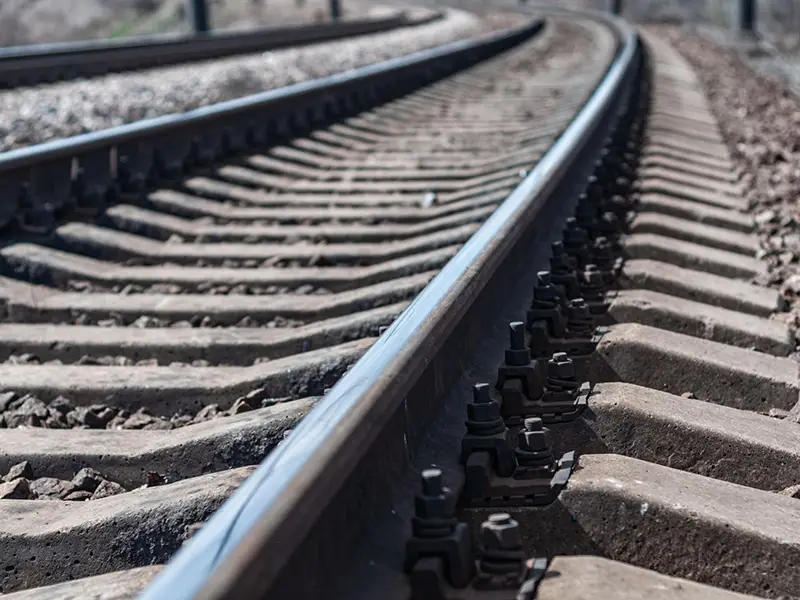
UIC60 rail grade selection requires more than comparing the hardness and tensile strength of R260 and R350HT. The right choice depends on how the rail performs under actual operating conditions, what type of deterioration is occurring, and whether a different grade is likely to address the problem.
UIC 60 Rail, commonly designated as 60E1 in EN 13674-1 rail specifications, identifies the rail profile. R260 and R350HT are steel grades that can be specified for this profile, subject to the applicable standard and project requirements.
In practice, R260 may remain suitable where wear and maintenance are under control. R350HT may warrant consideration where repeated wear or other rail damage is shortening service life. The decision should be based on inspection records, operating conditions, maintenance history, and the expected benefit of changing grades.
This guide explains how to assess R260 vs R350HT for UIC 60 rails and turn that assessment into a justified rail-grade selection.
Quick Answer: When Should You Assess R350HT?
The choice between R260 and R350HT should start with existing rail performance, not a predetermined percentage of harder rail for the entire line.
| Existing rail condition | Initial assessment |
|---|---|
| R260 meets the required service interval, with manageable wear and maintenance | Retaining R260 may remain appropriate |
| Repeated gauge-face or gauge-corner wear is shortening rail service life | Assess R350HT as a potential alternative |
| Head checks or other rolling contact fatigue defects are recurring | Investigate the damage mechanism and maintenance strategy before changing grades |
| Damage is concentrated near traction or braking locations | Investigate operating and wheel–rail contact conditions |
| Defect records are incomplete or the cause is unclear | Collect more evidence before specifying a different grade |
Final selection must follow the infrastructure manager’s requirements, the project specification, and the applicable engineering approval process.
1. Understand What R260 and R350HT Tell You
UIC 60 and 60E1 describe the rail profile, while R260 and R350HT describe the steel grade. Keeping these designations separate helps prevent a common specification error: treating a rail profile and its material grade as if they were the same thing.
The principal difference between R260 and R350HT is their specified mechanical properties and material condition.
| Property | R260 | R350HT |
|---|---|---|
| Steel condition | Non-heat-treated pearlitic rail steel | Head-hardened pearlitic rail steel |
| Hardness range | 260–300 HBW | 350–390 HBW |
| Minimum tensile strength | 880 MPa | 1,175 MPa |
| Minimum elongation | 10% | 9% |
The higher specified hardness of R350HT is intended to improve resistance to wear under suitable operating conditions. However, hardness and tensile strength alone cannot predict the service life of a particular track section.
Actual performance also depends on wheel–rail contact, curve geometry, traffic, rail profiles, lubrication, and maintenance. A grade with higher specified hardness does not automatically produce a better outcome under every operating condition.
The key question is whether the performance difference between R260 and R350HT addresses the deterioration limiting service life on the section being assessed.
2. UIC60 Rail Grade Selection Starts with Track Conditions
A useful R260 vs R350HT assessment begins with the track’s operating and maintenance history.
For replacement projects, identify where the existing rail has required intervention and determine why. For new lines, use comparable-route experience where available, while accounting for differences in vehicles, traffic, geometry, and maintenance arrangements.
Divide the route into sections with reasonably consistent operating conditions and deterioration patterns. Record the following information for each section.
| Information to record | Why it matters |
|---|---|
| Track identity, chainage, curve radius, and rail position | Identifies where the problem occurs and distinguishes high-rail and low-rail conditions |
| Annual gross tonnage and accumulated traffic | Establishes traffic exposure and supports comparisons over time |
| Axle-load distribution, operating speed, and rolling-stock mix | Provides context for wheel–rail loading and contact conditions |
| Existing rail grade, installation date, and renewal reason | Establishes the rail’s service history |
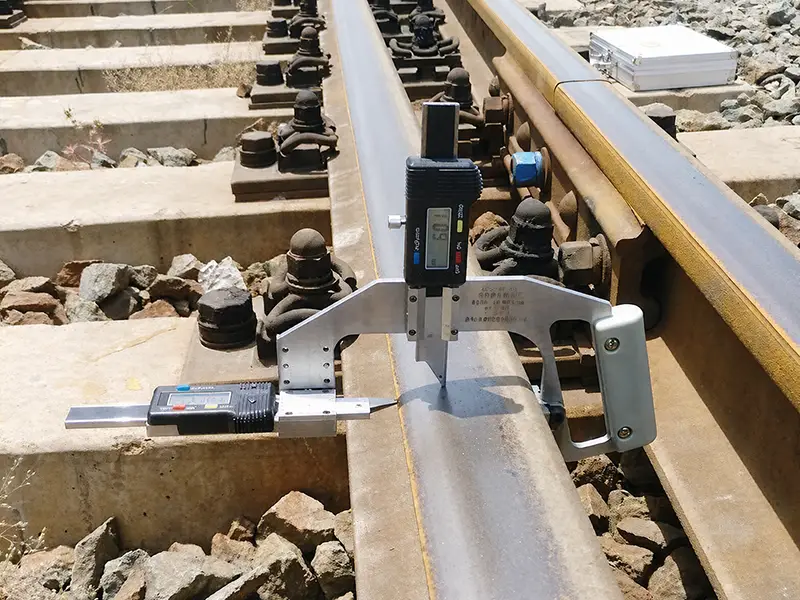
| Wear measurements and defect inspection records | Shows what is deteriorating and whether the condition is progressing |
| Grinding, lubrication, and rail-profile history | Helps identify maintenance factors that may influence performance |
Annual gross tonnage and axle load should not be treated as interchangeable. Tonnage describes accumulated traffic exposure, while axle load is one factor influencing wheel–rail contact forces and loading conditions.
For existing UIC 60 rails, the most useful starting question is often: What caused the previous rail to require maintenance or replacement?
If R260 has delivered acceptable service life with manageable maintenance, a grade change may not offer enough additional value. If repeated wear or fatigue-related defects are limiting performance, a closer assessment of R350HT may be justified.
3. Match the Deterioration Mechanism to the Grade Selection
Once the on-site data and maintenance records have been obtained, first determine the primary cause of damage to this section of track. Even for the same UIC 60 rail cross-section, different investigative approaches are required depending on the specific issues at hand.
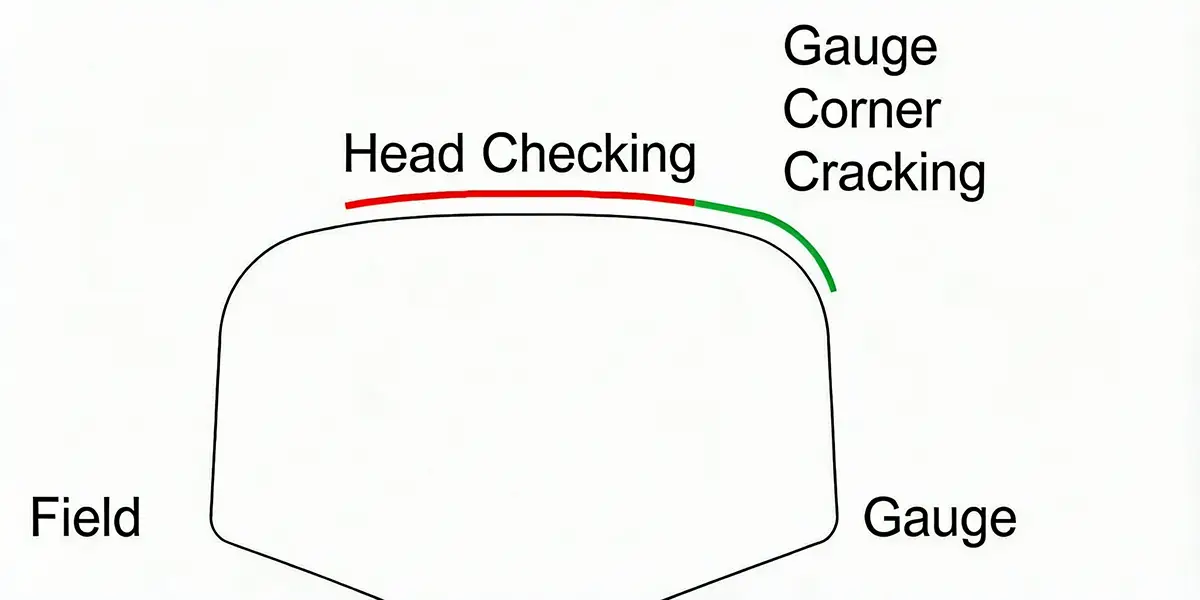
Repeated gauge-face or gauge-corner wear
Where measured wear is progressively shortening rail service life, assess whether R350HT could improve wear performance.
Check the curve geometry parameters, wheel and rail profiles, lubrication conditions, and the trend of wear measurement changes. This will help determine whether switching to a different steel grade might resolve the issue, or if adjustments to contact management and maintenance practices are also required.
Head checks and other rolling contact fatigue defects
Rolling contact fatigue (RCF) includes surface and near-surface damage caused by repeated wheel–rail contact. Head checks are one form of RCF that can develop along the rail head, particularly in demanding contact conditions.
Examine defect depth and progression, rail profiles, grinding history, and other relevant contact conditions. R350HT may be a candidate where the operating evidence and approved design support its use. The assessment should still consider how wear and fatigue interact under the proposed maintenance regime.
Deterioration near traction or braking locations
Straight track is not automatically a low-demand location.
Concentrated traction and braking can influence wheel–rail contact conditions and contribute to different forms of rail deterioration. When defects cluster around these locations, investigate the operating conditions and identify the actual damage mechanism before proposing a grade change.
Recurring defects with an unclear cause
Where the cause of repeated damage is uncertain, avoid treating a grade change as the diagnosis.
Additional inspections, repeatable measurements, and a review of maintenance records may be necessary before comparing R260 and R350HT fairly.
Why curve radius alone cannot determine the grade
Curve radius is an important screening factor, but there is no single radius that universally determines when R260 should be replaced by R350HT.
A 2026 study of 212 curved track sections made from R260 steel on the Belgian railway network found the highest head-check growth rate in sections with curve radii of 750–1,000 m. The result provides useful evidence about deterioration on that network, but it is not a universal grade-selection threshold.
The study also highlighted the relationship between head-check growth, rail wear, and annual traffic conditions.
4. Turn the Assessment into a UIC 60 Rail-Grade Allocation Plan
The next step in UIC60 rail grade selection is to translate the findings into a section-by-section allocation schedule.
The purpose is to document which grade is being considered, why it is being considered, and what evidence is still needed before the proposal can be approved.
The following is an illustrative assessment, not a real project specification.
| Track section | Observed condition | Initial grade direction | Further checks |
|---|---|---|---|
| Section A | R260 meets the required service interval and maintenance remains manageable | Evaluate retaining R260 | Confirm future traffic and maintenance assumptions |
| Section B | Repeated gauge-corner wear with documented progression | Assess R350HT as an alternative | Review wear measurements, lubrication, rail profiles, and expected service benefit |
| Section C | Recurring head checks, with incomplete grinding records | Defer the grade decision pending investigation | Establish defect progression, contact conditions, and maintenance history |
This process separates an observed problem from a proposed material solution.
For each section, record:
- Start and end chainage.
- Rail profile and current grade.
- Observed deterioration and the reason for intervention.
- Proposed grade and supporting evidence.
- Maintenance assumptions and outstanding checks.
- Rail lengths, quantities, and inspection requirements.
Before construction, review the extent of each grade change, whether the proposal covers both rails or a separately approved arrangement, and how grade boundaries relate to rail lengths and joint locations.
Grade transitions also require specific attention. The joining method and approved welding procedure must cover the actual material combination and the relevant project requirements. A procedure approved for R260 should not automatically be assumed suitable for R350HT or for a dissimilar-grade joint.
The result should be a documented allocation plan in which every proposed change has a clear technical reason. There is no need to establish a target percentage of R350HT before the track assessment begins.
5. Include Maintenance and Monitoring in the Grade Decision
Selecting a steel grade is only one part of managing rail performance. The maintenance plan remains essential after a grade change.
For each section under assessment, define how wear and defects will be monitored. Depending on the operating conditions and infrastructure manager’s requirements, this include:
- Repeatable rail-wear measurements at defined locations.
- Rail-profile measurements and review of wheel–rail contact conditions.
- Inspection and recording of relevant surface defects.
- Grinding dates, intervention criteria, and recorded metal removal.
- Lubrication performance where applicable.
- Traffic accumulated between inspections and interventions.
Use consistent measurement locations and methods to compare results over time.
Accumulated gross tonnage is useful when comparing deterioration under different levels of traffic exposure. It should not, however, automatically take the place of calendar time or maintenance intervals. The way traffic is distributed throughout the year, along with wear rates and grinding practices, can also affect how rail defects develop.
If the benefits of changing grades are still unclear, a monitored comparison or trial can help establish local evidence, provided the infrastructure manager allows it. Record the grades, track locations, maintenance conditions, and measurement methods so that any differences can be assessed fairly.
The aim is to establish whether the chosen grade provides the required performance under the maintenance regime that will be used in practice, rather than judging it solely by how little visible wear it shows.
6. Compare Lifecycle Costs for R260 and R350HT
Economic assessment should follow the identification of candidate sections and their principal deterioration mechanisms.
Compare the two grades over the same physical scope and an appropriate evaluation period. Include relevant differences in:
- Rail material and installation costs.
- Joining, welding, and required inspection.
- Grinding, lubrication, and other maintenance.
- Future rail renewal and associated installation work.
- Track access or possession requirements, where these can be estimated consistently.
The largest uncertainty is often the expected service-life benefit of changing grades. Avoid applying a fixed improvement factor unless it is supported by comparable operating evidence.
A sensitivity assessment can test three scenarios.
| Scenario | Purpose |
|---|---|
| No service-life improvement | Tests whether the proposal remains justifiable if the expected benefit does not occur |
| Conservative improvement | Examines the economics under a modest, explicitly stated benefit assumption |
| Evidence-supported improvement | Uses relevant site records, comparable-route experience, or a suitable monitored trial |
Keep the assumptions visible and consistent between alternatives. If R350HT is expected to reduce a particular form of wear, the assessment should still account for the maintenance and other interventions required under the proposed operating plan.
A higher initial material cost may be justified when the evidence supports a meaningful lifecycle benefit. Equally, where R260 already meets the required performance, a change may not offer sufficient additional value.
The purpose of the comparison is to support a defensible decision for each section, not to maximise the amount of R350HT specified.
From Rail-Grade Selection to UIC 60 Rail Specifications
Once the required grade has been established, the next step is to define the supply specification.
The UIC 60 rail specifications and processing options page provides information on the 60E1 profile, dimensions, available material options, and processing requirements.
Before ordering, confirm the approved steel grade, required rail lengths, quantities, machining or joint-hole requirements, inspection documentation, and delivery destination. Availability and manufacturing requirements should be verified against the approved project specification rather than assumed from the profile designation alone.
For project-specific cutting, drilling, bending, or other machining requirements, see Glory Track’s rail processing services.
Need UIC 60 rails for an approved project specification?
Share the specified profile, approved steel grade, required lengths, quantity, processing requirements, and delivery destination to request a UIC 60 rail quotation.
Frequently Asked Questions
Does a curve below a particular radius always require R350HT?
No universal curve-radius threshold applies to every railway. Radius is one screening factor; traffic, wheel and rail profiles, lubrication, maintenance, and infrastructure manager requirements also matter.
Can R350HT be installed only on the high rail of a curve?
Do not assume that a single-rail arrangement is suitable based on gauge-face wear alone. The proposal needs an engineering basis and approval under the applicable infrastructure requirements, including consideration of grade transitions and joining.
What if existing wear and defect records are incomplete?
Document the uncertainty and establish a suitable inspection and monitoring baseline before fixing the grade allocation. A monitored comparison may help build local evidence if it is permitted and properly controlled.