
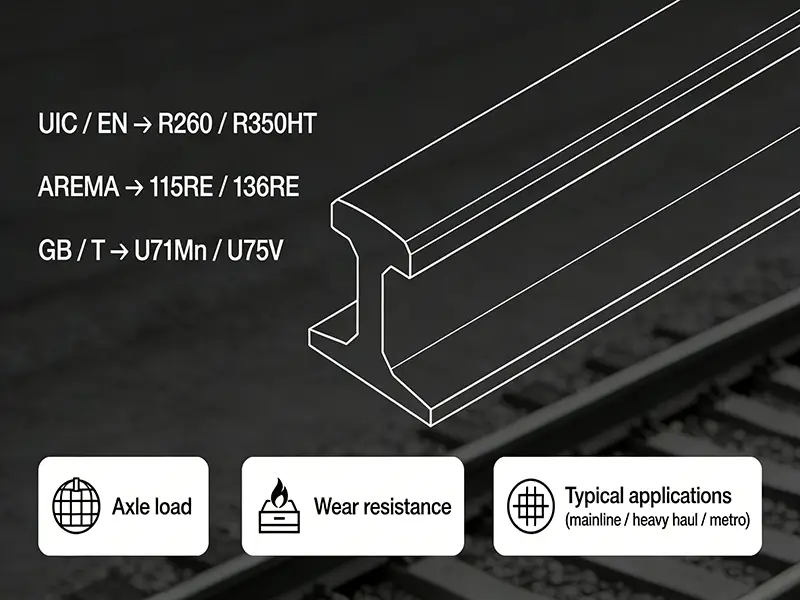
Selecting the right railroad track steel grade is a key decision. It affects the safety, capacity, and long-term cost of any rail infrastructure. Multiple global standards exist, including UIC, AREMA, and GB. Choosing the proper grade can be complex. This guide explains the main standards and helps you make an informed choice.
Why the Steel Grade Directly Affects Performance and Cost
Railroad track steel must handle forces very different from structural steel. It faces constant dynamic pressure from rolling wheels, along with severe friction and impact loads. Choosing the wrong grade causes premature wear, rolling contact fatigue, and rail deformation. These issues create safety risks and drive frequent, costly maintenance or early rail replacement. Selecting the right railroad track steel grade for your operating conditions is critical to long-term reliability and project cost control.
Understanding the Major Global Standards
Rail projects typically align with one of three primary standard systems, each dominant in different regions.
1.UIC/EN Standards (International Projects & Common in Europe)
The primary criterion used by these standards to categorize rails is their minimum tensile strength (in MPa). Performance expectations are made obvious by the grade classification. R260 and R350HT are common grades.
Important Features:
For mainline passenger and freight routes, the typical grade is R260. It provides a great mix of wear resistance and strength.
R350HT (Head Hardened): To achieve exceptional surface hardness, the rail head is heat-treated. It is designed for high-tonnage routes, severe curves, and heavy-haul corridors where wear is the main issue.
2. AREMA Specifications (Standard in North America)
North American railroads have incorporated the AREMA manual into their operations, particularly for large freight.
Common Designations: Section weight (e.g., 115RE, 136RE) or carbon content (e.g., 0.74%-0.86% C) are frequently used to specify rails.
Key Features: The standards suit established local maintenance and welding methods by emphasizing exact chemical composition and dimensional limits.
3. GB/T Standards (Widely Used in China & Global Projects)
China’s GB standards are widely used in international projects and have developed in tandem with its extensive high-speed and heavy-haul networks.
U71Mn and U75V are common grades.
Important Features:
The most popular grade for mainlines is U71Mn. It offers performance on par with R260 and is acknowledged as a dependable and affordable option for numerous international projects.
U75V is a low-alloy, high-strength steel that has been micro-alloyed with vanadium. It is appropriate for heavy-haul lines with axle loads greater than thirty tons and high-speed rail because of its exceptional tensile strength and wear resistance.
How to Select the Correct Rail Steel Grade: Key Factors
- The main factors are Axle Load and Traffic Type. Higher strength classes (such as R350HT or U75V) are required to withstand deformation under higher axle loads (such as 35t vs. 25t).
- Annual Traffic Volume (MGT/year): Wear life is predicted by the number of gross tons moved annually. More wear-resistant steels help prolong maintenance cycles on high-density routes.
- Environmental Conditions: Corrosion resistance may need to be taken into account in coastal or extremely humid areas. Steels with good low-temperature toughness are essential in extremely cold areas.
- Project Scope (New Build vs. Replacement): Weldability and geometric compatibility with the current rail must be taken into account for replacement projects.
Common Mistakes in Rail Steel Selection
Avoid these pitfalls to ensure optimal performance and cost-efficiency.
Specifying for Maximum Hardness Only: Too much hardness will weaken toughness and increase the likelihood of brittle fracture or crack propagation in cold temperatures or under impact. The secret is to strike a balance between toughness and hardness.
Focusing Only on the Initial Purchase Price: Because of its quicker wear, more frequent grinding, and earlier replacement, lower-grade steel frequently has a higher long-term cost. An examination of life-cycle costs is crucial.
Ignoring Weldability: There are distinct weldability profiles for various grades and heat treatments. The steel that is chosen needs to work with the intended in-field welding procedures.
Matching Standards to Real-World Applications
Extreme wear resistance is the top goal for heavy-haul mining railroads (axle load > 35t). Usually, you need a micro-alloyed grade like U75V (GB) or a premium head-hardened grade like R350HT (UIC).
Optimal balance is the aim of the Mainline Mixed-Traffic Corridor (Axle Load ~25t). The standard, tried-and-true options for this duty are R260 (UIC) or U71Mn (GB).
Urban Metro System: Although axle loads are reduced, vibration and noise reduction are crucial. For acoustic optimization, a standard grade such as R260/U71Mn is sufficient and frequently combined with precise grinding.
Conclusion
Matching material capabilities to operational need is the key to choosing railroad track steel. There isn’t a single “best” grade. You can make a data-driven choice by comprehending the reasoning behind the performance-based UIC, practice-based AREMA, and high-performance GB/T standards.
Align the steel’s qualities with your axle loads, traffic density, and environment, and give a full life-cycle view priority over initial cost. This strategy guarantees that the foundation of your rail infrastructure is one of long-term value, efficiency, and safety. Modern GB-standard rails, such as U71Mn and U75V, provide an attractive blend of proven performance and project economics for numerous international projects.