
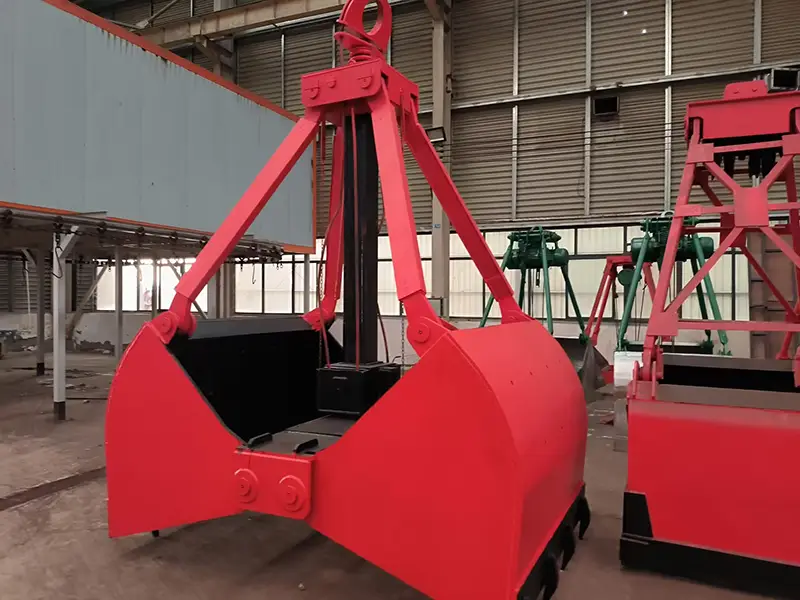
In heavy-duty material handling, the crane grab bucket is far more than a simple attachment—it is a performance multiplier. Yet many buyers still select grab buckets based only on lifting capacity or price, assuming that “a grab is a grab.”
This approach often leads to reduced productivity, excessive wear, and even safety risks.
Choosing the right crane grab bucket can increase handling efficiency by over 20%, reduce maintenance costs, and significantly improve operational safety. This guide explains how to select the right grab bucket, step by step, based on material characteristics, grab types, crane configuration, and operational goals.
I. Understanding Common Types of Crane Grab Buckets
Before making any decision, it’s essential to understand the main types of grabs and where they perform best.
Mechanical Grab Bucket
Mechanical grabs operate using wire ropes and do not require an external power source. They are lightweight, cost-effective, and easy to maintain, making them ideal for high-frequency bulk handling in ports and yards. However, they rely heavily on crane configuration and operator skill.
Typical applications: coal, ore, grain, bulk cargo handling.
Clamshell Grab
The clamshell grab features two or four shells that close tightly, offering excellent sealing and a high filling rate. It is the preferred choice for loose bulk materials where spillage control matters.
Best for: coal, cement, fertilizer, grain, ore powder.
Orange Peel (Multi-Tine) Grab
Designed with multiple curved tines, orange peel grabs excel at handling irregular and bulky materials. Their structure allows deep penetration and secure gripping of uneven loads.
Common uses: scrap metal, demolition waste, rocks, timber.
Hydraulic & Electro-Hydraulic Grab
Hydraulic systems provide strong gripping force, smooth motion, and precise control. Electro-hydraulic grabs integrate motors and pumps directly into the grab body, requiring only one hoisting rope.
Applications: scrap yards, recycling plants, shipyards, heavy industrial sites.
II. Key Material Factors That Define Grab Selection
1. Material Type and Shape
The first question is simple: what are you lifting?
- Bulk materials (coal, grain, ore powder) require high filling efficiency and good sealing.
- Irregular materials (scrap steel, construction waste) require penetration strength and stable gripping.
This single distinction often determines whether you need a clamshell grab or a multi-tine grab.
2. Density and Weight
Material density directly affects grab volume.
For example, scrap steel may weigh over 6 times more than grain per cubic meter. A large-volume grab suitable for grain would overload a crane when used for scrap.
Correct volume selection ensures:
- Full utilization of crane capacity
- Stable lifting without overload risks
3. Flowability and Particle Size
Fine, free-flowing materials demand tight sealing to prevent leakage.
Sticky or wet materials may require anti-adhesion designs or special coatings.
4. Abrasion and Corrosion
Highly abrasive materials accelerate wear, while corrosive environments demand resistant steels and sealed systems. Material selection here directly impacts service life.
III. Choosing the Right Grab Shape
Clamshell Grab: Ideal for Bulk Materials
Clamshell grabs offer:
- High fill rates
- Excellent sealing
- Fast opening and closing cycles
They are the most efficient solution for continuous bulk handling operations.
Multi-Tine Grab: Built for Irregular Loads
Multi-shell or orange peel grabs provide:
- Strong penetration into material piles
- Secure gripping of uneven shapes
- Wide adaptability to varying material sizes
Quick rule:
Uniform, loose material → clamshell grab
Irregular, bulky material → multi-tine grab
IV. Mechanical vs. Hydraulic Drive Systems
Mechanical Grab Buckets
Mechanical grabs operate via wire rope movement and require double-drum cranes.
Advantages:
- Lightweight
- Low maintenance
- Fast cycle times
- Lower upfront cost
Limitations: Not compatible with single-rope cranes.
Hydraulic Grab Buckets
Hydraulic and electro-hydraulic grabs work with single-rope cranes and provide superior control.
Advantages:
- Strong gripping force
- Smooth, precise operation
- Suitable for complex or heavy-duty tasks
- Optional rotation and remote control
They are ideal when precision, safety, and adaptability matter more than speed alone.
V. Verifying Crane Compatibility
Never select a grab bucket without checking crane parameters.
Key checks include:
- Rated lifting capacity: grab weight + load weight + safety margin
- Number of drums: mechanical grabs require dual drums
- Wire rope diameter: must match grab sheave design
- Power supply: required for electro-hydraulic grabs
Ignoring compatibility is one of the most common causes of equipment failure and safety incidents.
VI. Matching Grab Selection to Operational Goals
Different operations prioritize different outcomes:
- Maximum efficiency: high fill-rate grabs, lightweight designs
- Low maintenance: mechanical systems, wear-resistant materials
- High safety & precision: hydraulic grabs, remote control systems
- Harsh environments: corrosion-resistant steel, reinforced sealing
The best crane grab bucket is not the most expensive—it’s the one that fits your operation.
Conclusion
Selecting the right crane grab bucket is a systematic process, not a guesswork decision. By analyzing material properties, choosing the correct grab type, matching drive systems, and verifying crane compatibility, you ensure higher efficiency, lower costs, and safer operations.
If you’re unsure which grab suits your crane and materials, professional guidance can save significant time and investment. A properly selected grab doesn’t just lift materials—it lifts your entire operation’s performance.