
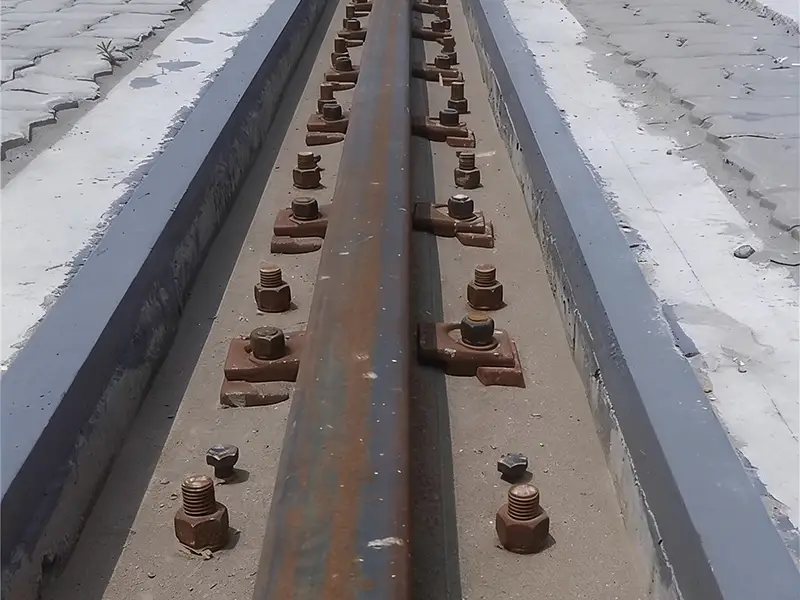
In modern ports, crane performance depends heavily on rail stability. As equipment becomes larger and more automated, traditional rail fastening methods are no longer enough. High-performance rail clips for cranes now play a critical role in controlling vibration, distributing wheel loads, and extending the service life of crane rail systems. Choosing the right fixing method is no longer just a design detail—it directly affects safety, maintenance costs, and long-term operational efficiency.
Today, port crane rail systems typically rely on two fixing approaches:
- Traditional rigid fastening systems
- Flexible rail fixing systems
This guide compares both solutions in terms of load performance, maintenance, durability, and long-term cost—helping port designers, contractors, and equipment buyers choose the right rail clips for cranes.
Basic Characteristics of the Two Rail Fixing Systems
Traditional Rigid Rail Fixing System
Rigid systems were widely used in early port construction projects.
Key features include:
Rail joints:
Rails are connected using fishplates, forming jointed track sections. Standard rail lengths range from 12–25 meters, with expansion gaps of about 5 mm between rails.
Fixing method:
Rigid rail clips directly clamp the rail to the foundation. Anchor bolts connect the clips to concrete, creating steel-to-steel contact.
Foundation structure:
Reinforced concrete sleepers or continuous concrete beams with embedded bolts.
While this system is technically mature, it lacks elastic buffering under heavy crane loads.
Flexible Rail Fixing System
After 2000, flexible systems became the preferred solution for new port construction.
Key features include:
Welded continuous rails:
Rails are welded into long continuous sections, sometimes extending hundreds of meters. Expansion allowances are reserved only at both ends.
Elastic rail clips for cranes:
Instead of rigid contact, flexible rail clips incorporate vulcanized rubber noses that provide elastic clamping force. The clip and anchor bolt are arranged separately for improved performance.
Continuous elastic rail pads:
A 7 mm synthetic rubber pad sits between the rail and concrete foundation. It distributes wheel loads evenly and absorbs vibration.
This design transforms the rail system into a controlled elastic structure rather than a rigid one.
Performance Comparison
Load Distribution and Impact Resistance
Rigid system:
Wheel loads transfer directly to the concrete foundation. Without elasticity, impact forces concentrate around bolts and rail seats. Over time, this leads to bolt loosening, rail wear, and potential cracking.
Flexible system:
Elastic rail clips for cranes and continuous pads create a composite damping structure. The load spreads evenly across the foundation, reducing fatigue stress and minimizing rail-bottom wear.
Benefits include:
- Lower vibration levels
- Reduced noise
- Longer foundation life
- Improved crane stability
Rail Connection Method
Fishplate joints (rigid system):
- Geometric discontinuities at every joint
- Higher impact loads
- Frequent inspection required
- Increased fatigue risk
Welded joints (flexible system):
- Smooth rail alignment
- Reduced impact forces
- Longer service life
- Better high-speed crane performance
However, welded rails require proper temperature stress management.
Adjustability and Maintenance
Rigid fixing:
- Limited post-installation adjustment
- Height correction requires disassembly
- Higher labor intensity
Flexible rail clips for cranes:
- Slotted clip holes allow lateral adjustment
- Adjustable systems compensate for settlement
- Some designs include self-locking wedge mechanisms to prevent clip movement
Maintenance becomes faster and more predictable.
Temperature Stress Management
Jointed rails (rigid system):
Expansion gaps allow each rail section to expand independently. Temperature stress is minimal.
Continuous welded rails (flexible system):
- Expansion allowance: typically 50–300 mm depending on rail length and temperature range
- End stops control longitudinal movement
- Elastic fastening allows controlled micro-sliding
This prevents stress accumulation while maintaining structural stability.
Advantages and Disadvantages
Traditional Rigid System
Advantages:
- Mature technology
- Easy single-rail replacement
- Simple temperature management
Disadvantages:
- Frequent bolt loosening
- Faster rail wear
- Higher vibration and noise
- Uneven load distribution
- Shorter service life
Flexible Rail Fixing System
Advantages:
- Smooth crane travel
- Even wheel load distribution
- Reduced impact stress
- Longer rail and foundation lifespan
- Lower maintenance cost
- Adjustable and self-locking designs
Disadvantages:
- Higher installation precision required
- More complex temperature design
- 15–30% higher initial investment
However, lifecycle cost is typically lower.
Transition Between Old and New Systems
Port expansion projects often require connecting jointed rail systems with continuous welded rails.
Recommended transition approach:
- Install a specially designed transition section
- Weld transition rails into the flexible system
- Reinforce rail web in the transition zone
- Determine expansion slot length based on rail length and local temperature range
- Place transition segments outside active crane working areas
Proper transition design ensures structural integrity and long-term reliability.
Which System Should You Choose?
For new port projects:
Flexible rail fixing systems with high-performance rail clips for cranes deliver better long-term value and lower maintenance costs.
For retrofit projects:
Evaluate existing foundations carefully. System upgrades are possible but require detailed engineering and controlled transition solutions.
Conclusion
Rigid and flexible rail fixing systems serve different stages of port development, but modern high-capacity terminals increasingly favor elastic solutions for improved load distribution, reduced vibration, and longer service life.
Selecting the right rail clips for cranes directly impacts crane stability, maintenance frequency, and overall lifecycle cost. With extensive experience in crane rail fastening systems, Glory Track supports port projects with engineered solutions designed for demanding operating conditions.