
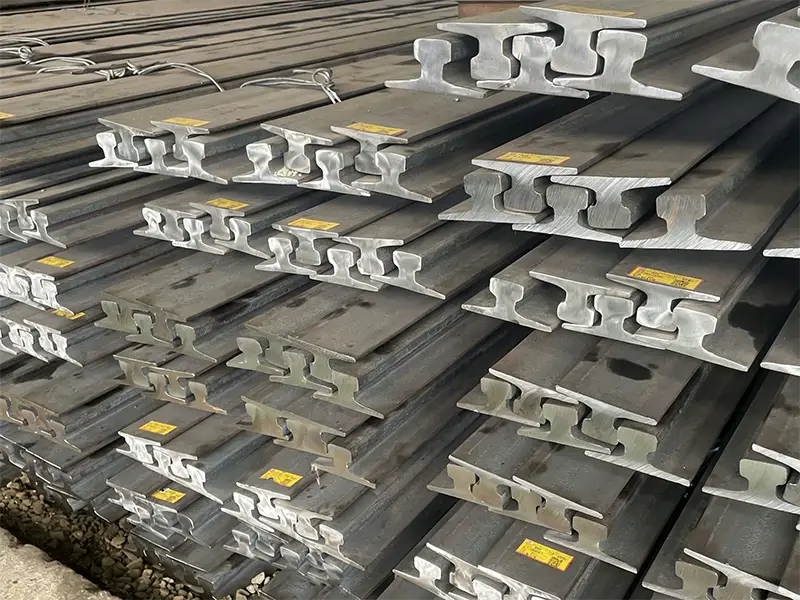
A Quick Comparison of A75 Rail and QU70 Rail
Although A75 rail and QU70 rail are both widely used in crane runway systems, their cross-section profiles and dimensional proportions differ significantly.
A75 rails belong to the DIN 536 crane rail series, while QU70 rails are part of the Chinese QU-type crane rail system. Even though the head width of the two rails appears similar, their height, base width, and web thickness vary significantly, which affects their performance in different crane applications.
Both rails are typically manufactured from U71Mn steel, a high-strength material widely used for crane rails due to its excellent wear resistance and load-bearing capacity.
Overview of A75 Rail
At Glory Track, we find that A75 is one of the most popular models in the DIN 536 crane rail series. It is primarily used in gantry crane systems, with some clients customizing it into short rails for trolley rail applications.
A75 rail features a wide base and a relatively narrow head, a profile designed for stable installation on crane runway beams.
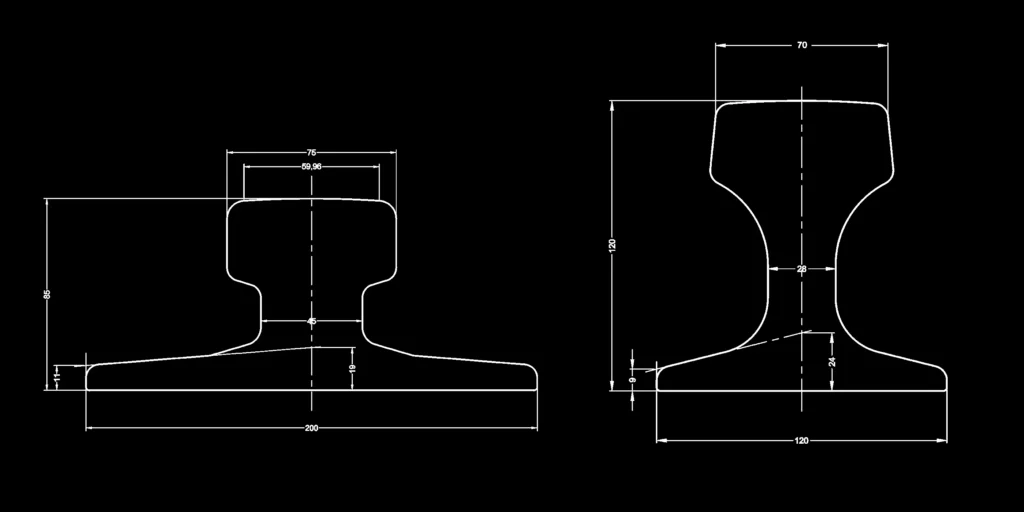
Typical dimensions of A75 rail include:
- Head width: 75 mm
- Rail height: 85 mm
- Base width: 200 mm
- Web thickness: 45 mm
- Weight: 56.2 kg/m
This structure allows the rail to handle heavy crane loads while maintaining reliable support in demanding industrial environments.
Overview of QU70 Rail
QU70 rail belongs to the QU-series crane rails, which are widely used in China as well as in many international industrial projects.
Compared with A-series crane rails, QU rails feature a more balanced profile, where the rail height and base width are roughly the same. This structural design provides strong vertical load capacity while keeping the rail footprint relatively compact.
The designation QU70 comes from its 70 mm rail head width.
Typical dimensions of QU70 rail include:
- Head width: 70 mm
- Rail height: 120 mm
- Base width: 120 mm
- Web thickness: 28 mm
- Weight: 52.8 kg/m
QU70 rails are widely used in overhead crane systems, particularly in factory workshops and industrial plants where QU-type crane wheels are commonly applied.
A75 Rail vs QU70 Rail: Key Differences
| Feature | A75 Rail | QU70 Rail |
|---|---|---|
| Rail Type | DIN crane rail | QU series crane rail |
| Head Width | 75 mm | 70 mm |
| Rail Height | 85 mm | 120 mm |
| Base Width | 200 mm | 120 mm |
| Web Thickness | 45 mm | 28 mm |
| Weight | 56.2 kg/m | 52.8 kg/m |
| Steel Grade | U71Mn | U71Mn |
| Profile Shape | Wide base, narrow head | More balanced height and base |
The table highlights the main structural differences between the two rails, particularly in base width, rail height, and web thickness, which influence their load distribution characteristics in crane runway systems.
Structural Design Differences
The cross-section of a crane rail affects how loads move through the crane wheel, rail, and runway beam. Rail geometry influences load distribution, structural stability, and overall crane performance.
A75 Rail Structure
A75 rails have a very wide base and a thick web. This profile gives the rail strong lateral stability on crane runway beams.
The wide base spreads loads across a larger support area. This helps reduce stress concentration and keeps the rail stable during heavy crane operation.
QU70 Rail Structure
QU70 rails have a taller and more compact profile. The rail height and base width are almost the same.
This shape focuses on vertical load capacity. It works well in crane systems with high wheel loads and strict alignment requirements.
A75 vs QU70 Rail Cross-Section Comparison
Applications: When to Use A75 or QU70 Rail
Both rails are widely used in crane systems, but they often appear in different operating environments.
A75 rails are commonly used in:
- port cranes and container terminals
- shipyard gantry cranes
- shipbuilding and marine engineering yards
- heavy-duty crane systems in large industrial facilities
In many port crane projects, A75 rails are also processed into short rails for trolley rail systems, especially for ship-to-shore crane trolleys.
These environments typically involve high loads, outdoor operation, and continuous crane movement, where a rail with a wide base and strong stability is preferred. A75 rails are therefore frequently selected for port machinery and shipyard crane systems.
QU70 rails are more commonly used in:
- overhead cranes in factory workshops
- plant crane runways
- equipment maintenance workshops
- general industrial lifting systems
In these settings, cranes usually operate inside factory buildings with relatively shorter travel distances and frequent lifting cycles. QU-type rails are widely adopted in these applications due to their compact profile and strong vertical load capacity.
Although both rails can be used for bridge cranes and gantry cranes, the final selection often depends on crane wheel design, project standards, operating environment, and runway structure.
Conclusion
Both A75 rail and QU70 rail are widely used in crane runway systems, but they belong to different crane rail design series and are typically selected for different crane applications.
Understanding these differences helps engineers choose the most suitable rail type based on crane design and operating conditions.
Glory Track supplies both A-series crane rails and QU-series crane rails, with options for custom lengths, machining, and rail system solutions. If you are planning a new crane project or upgrading an existing rail system, our team can help you select the appropriate rail specification.