
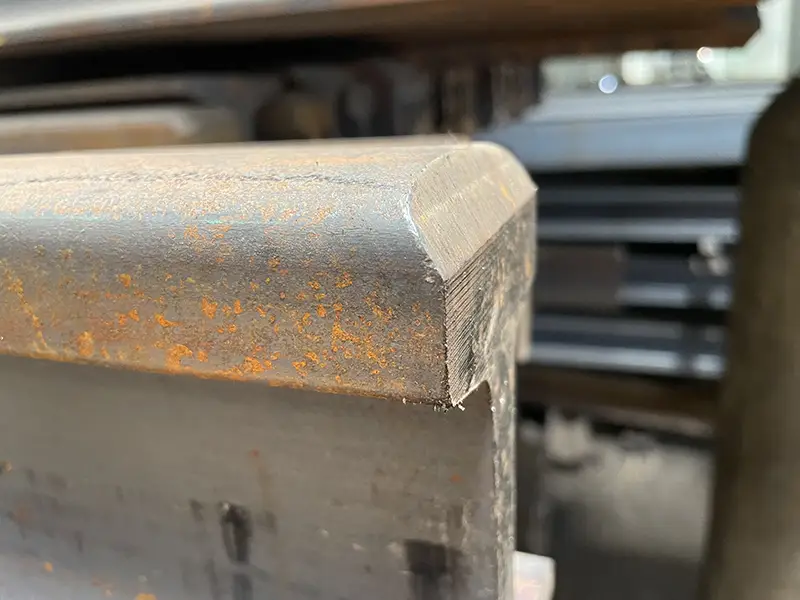
In the modern era of high-speed and heavy-haul railway transportation, the Continuous Welded Rail (CWR) has become the global standard. By eliminating thousands of traditional rail joints, CWR significantly enhances the smoothness and safety of train operations. However, achieving this “seamless” goal relies on a technical process that is often overlooked but structurally vital: Rail Head Beveling.
Understanding Rail Head Beveling vs. Mitre Cutting
In the field of track maintenance, it is common to confuse Rail Head Beveling with “mitre cutting.” While both involve machining the rail end into a slope, their mechanical purposes are distinct.
Mitre Cutting: Typically involves cutting the rail end at a longitudinal angle (such as 45° to 60°). This is a temporary joint solution used for emergency repairs or expansion joints, allowing wheels to transition with reduced impact while remaining a “jointed” system fixed by fishplates.
Rail Head Beveling: This is a precision preparation for permanent welding. It involves machining specific geometric slopes, angles, and dimensions onto the rail head, web, and foot. The primary objective is to ensure heat penetrates the core of the joint during welding, resulting in a full-penetration weld that transforms the rail into a single, high-strength “seamless” unit.
Simply put, mitre cutting is for “transition,” while Rail Head Beveling is for “integration.”
Why Is Precise Rail Head Beveling Essential?
The complex “I” cross-section of a steel rail—with varying thicknesses between the head, web, and base—presents significant welding challenges. Rail Head Beveling addresses these through three core functions:
- Ensuring Full Section Penetration
Without a proper bevel, welding heat cannot reach the root of the joint uniformly. Rail Head Beveling guides the arc or thermit flow deep into the joint, ensuring every millimeter of metal from the base to the running surface is fully fused, preventing defects like “lack of fusion.” - Optimizing Weld Quality and Stress Control
A well-designed bevel provides a channel for slag and gases to float to the surface, reducing internal porosity. Furthermore, symmetrical or asymmetrical bevel designs help balance heat input, minimizing residual stress and post-weld deformation. - Achieving High-Precision Smoothness
After welding, the joint typically undergoes precision grinding. The objective is to achieve a surface smoothness that aligns with stringent tolerances—often aiming for a deviation within 0.2mm depending on the specific track standard. This level of precision, made possible by accurate Rail Head Beveling, ensures the rail head profile matches the parent rail, effectively neutralizing wheel-rail impact.
Common Types of Beveling and Technical Standards
Different welding technologies require specific Rail Head Beveling profiles:
| Bevel Type | Characteristics & Applications |
| Thermit Welding | Requires symmetrical slopes with a pre-set gap (usually 25-27mm) to accommodate the flow of molten steel. |
| Arc Welding | Typically uses “V” or “Double-V” (X-shaped) grooves to allow for multi-layer, multi-pass welding in the field. |
| Flash Butt Welding | While not a “V” groove, it requires an extremely smooth, high-precision flat bevel to ensure optimal metal extrusion during upsetting. |
Modern Trends in Rail Head Beveling Technology
As global rail standards tighten, Rail Head Beveling is moving toward automation and digitalization. Modern requirements often demand angle tolerances within ±1° and root face errors under ±0.5mm.
To meet these standards, Glory Steel Work emphasizes the use of portable, high-precision electric or hydraulic beveling machines. These tools can complete a high-quality full-section bevel in minutes, ensuring that even in harsh environments—be it extreme cold or high humidity—the rail ends are perfectly prepared for a defect-free weld.
Conclusion
Rail Head Beveling is the “unsung hero” behind the reliability of seamless tracks. It is a sophisticated blend of geometry, metallurgy, and welding science. By ensuring a perfect connection at every joint, this process allows high-speed trains to glide safely across continents.
At Glory Track, we understand that in the world of rail infrastructure, precision is the only standard. Whether providing components for high-speed passenger lines or heavy-duty mining transport, our focus on superior Rail Head Beveling preparation and high-standard rail products ensures that global “steel arteries” remain safe, smooth, and efficient. From the initial bevel to the final weld, Glory Track provides the foundational quality that keeps the world moving forward.