

In the vast field of infrastructure construction, rails are also a key part of modern transportation networks. Rail joints are connections between rails, typically using fishplates, bolts, and spring washers. It connects rails and turnouts at joints to maintain structural integrity, resisting wheel impact forces (longitudinal/lateral) and temperature-induced stresses. While resisting bending and displacement, it must also meet the requirements of rail expansion and contraction. As potential weak points, joints require careful design, installation and maintenance for track safety and smoothness.
Rail joints functionally vary as standard, insulated, frozen, bonded, special-shaped, expansion, vibration-damping, and welded types.
1.Standard Rail Joints: Basic Components
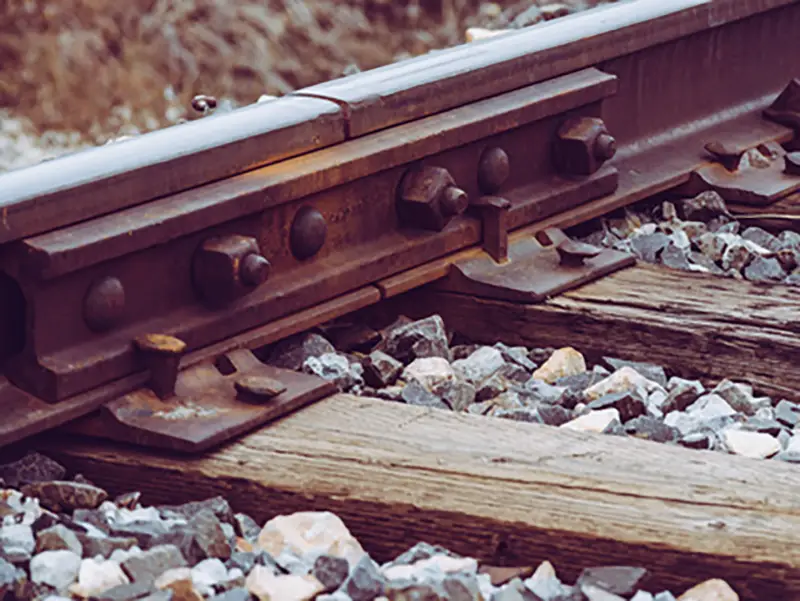
A standard rail joint consists of fishplates (commonly known as rail joints), bolts, and spring washers. This simple but efficient combination forms a unified structure allowing the track to withstand diverse train-exerted forces. From impact forces to continuous lateral/longitudinal loads and thermal stresses, the standard joint maintains stability. In addition, it cleverly accommodates the natural expansion and contraction of the rail. There exist multiple standard rail joint, with double-headed fishplates predominating in China. Double-headed fishplates better resist deflection and lateral displacement under vertical loads.
2.Insulated Joints: Circuit Safety
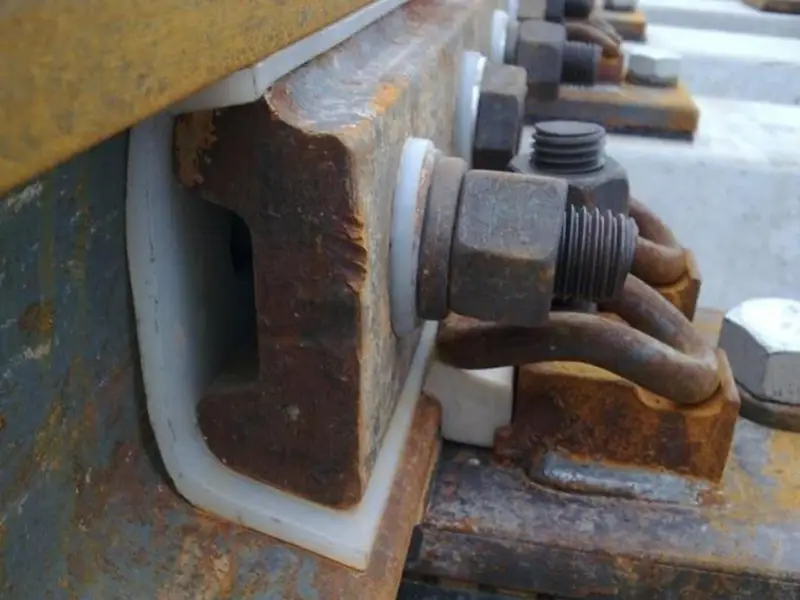
Insulated joints are used at the junction of two automatic block sections to ensure electrical isolation of adjacent rail sections and to ensure the normal operation of the track circuit. It is used to electrically isolate track sections by placing insulating material between the rails to prevent current from being conducted from one section of track to the other.
3.Frozen Joints: Thermal Locking

A frozen rail joint is a type of connection where fishplates and high-strength bolts are used to secure the rails. This ensures the rail ends fit tightly or leave a small gap, effectively limiting expansion or contraction of the rails. Currently, there are two main methods used internationally for freezing rail joints.
A.Normal frozen joints.
The normal frozen joint refers to a rail connection method that uses special gaskets to fill the gaps in the rail bolt holes to make the rail joints fit tightly and prevent the rails from expanding and contracting freely.
B.New-type frozen joints.
In recent years, new-type frozen track joints such as rail joint connections using the Spiralock anti-loosening mechanism, Huck fasteners and other connection forms, as well as MG joints, have emerged. Unlike conventional designs, these utilize high-strength bolted connections to generate sufficient rail-splint friction, restraining thermal movement. This demands bolts with both high strength and anti-loosening properties. The technology effectively immobilizes joints, reduces maintenance issues, and enables frozen tracks to match seamless line management standards.
4.Bonded Rail Joints: Seamless Integration

A bonded joint (or bonded insulated joint) integrates insulation for ultra-long seamless tracks, eliminating buffer zones. Manufactured as complete units or field-assembled, these joints enhance insulation, stress distribution, and load resistance. Insulating layers, reinforced sleeves, and track circuits are added at rail ends for durability.
Structurally, rail end joints include butt and miter types. Miter joints maximize adhesive shear strength via larger contact areas but require precision-pointed rail ends, increasing crack risks. Butt joints, though simpler, offer reliability and dominate practical applications.
5. Special-Shaped Joints: Transition Solutions

When different types of rails need to be connected, special-shaped joints (i.e. transition joints) come into play. These joints feature uniquely designed fishplates that conform to the contours of different rail sizes. During the installation process, special attention should be paid to aligning the gauge line and the highest point of the rail to ensure a smooth and safe connection. A common example is using a P60 rail with one end processed to match the cross-section of a P50 rail, allowing connection between rails with weights of 60kg/m and 50kg/m.
6.Expansion Joints: Bridge Applications

Expansion joints accommodate significant rail end movement in seamless lines, particularly on bridges exceeding 100m spans. They comprise paired base and switch rails mounted on a shared long tie plate, secured by specialized supports and clips. During thermal expansion/contraction, the switch rail slides along the base rail while maintaining alignment.
Expansion joints come in broken-line or curved types based on switch rail shape. This expansion joint type features an angled switch rail aligning with the base rail’s bent profile. The switch rail of the curved expansion joint is placed into a circular curve with a radius of 200 to 500 meters and is fixed on the large base plate. The stock rail is also bent into a curve with the same radius as that of the switch rail.
7.Vibration-Damping Joints: Noise Control

Vibration damping joints (bearing joints) are midline rail connections where the clipboard aligns flush with the rail head. When wheels pass, both the clipboard and rail surfaces contact simultaneously, distributing load evenly.
The clipboard’s dampening stiffness reduces wheel-rail folding angles and step impacts, ensuring smooth transitions that minimize vibration. This design effectively absorbs dynamic forces for stable track performance.
8.Welded Rail Joints: CWR Technology

The welded rail joint refers to the method of welding rails together to form continuous long rail sections. To ensure the welded joint has similar mechanical properties to the base rail and can safely withstand the thermal forces on seamless tracks, various welding methods can be used. Such as flash welding, gas pressure welding, and thermite welding. For example, the DIN-A series cranes, due to their low waist, often use welded connections for the rails.
Different types of rail joints offer unique benefits and are suited for various applications. You can select the most suitable track joint based on your specific needs. If you have any questions about rail joints or related products, or if you require expert advice, feel free to contact Glory Track. We are dedicated to providing high-quality products and services, including a wide range of track joints and customized rail head-cutting solutions.