

When a crane operates at high speeds, any failure in braking or positioning systems can cause the crane or trolley to collide with end stops due to inertia. To protect the crane and its components, crane buffers must be installed at key impact points—such as where the crane or trolley meets the end stop, between cranes running on the same track, and between dual trolleys on the same bridge.
As a crucial safety component, buffers absorb impact energy, reduce shock forces, and help the crane come to a smooth stop, preventing excessive impact from damaging the equipment.
The most common types of crane buffers include polyurethane buffers, hydraulic buffers, spring buffers, and rubber buffers. Each type has unique materials and working principles, making them suitable for different applications. The following section provides a detailed breakdown of these buffer types and their materials.
Material classification of Crane buffers
As mentioned above, crane buffers are mainly categorized into polyurethane buffers, hydraulic buffers, spring buffers and rubber buffers.
Polyurethane Buffer

This type of buffer contains a large number of micropores inside. It has a simple structure. During operation, it provides a soft impact, generating no noise or sparks, making it suitable for explosion – proof environments. It has nonlinear characteristics and is resistant to acid and oil. During the buffering process, it can absorb nearly 40% of the energy, with little rebound, good compressibility and excellent elasticity. The buffering stroke is 300mm, and it is suitable for use in the temperature range of – 20°C to + 60°C. The microporous structure of polyurethane functions like an air-damped spring, increasing its buffering capacity as impact speed rises.However, it is not ideal for metallurgical environments due to poor UV resistance, and its recommended service life is approximately one year.
Hydraulic Buffer
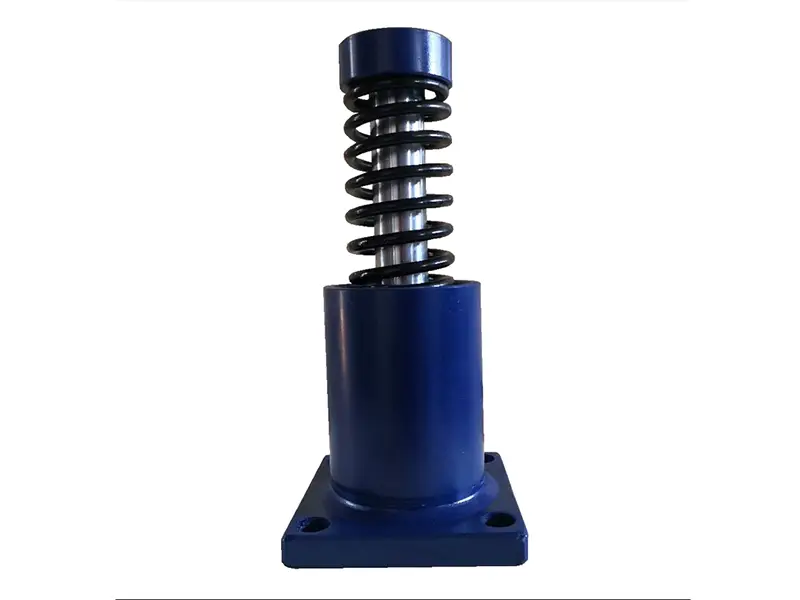
There are no special requirements for the operating environment of the hydraulic buffer.The hydraulic buffer functions by allowing liquid inside the cylinder to pass through many small holes into the oil reservoir when impact force is applied. Due to the damping effect of these small holes, it can absorb kinetic energy and convert it into the heat energy of the oil. The hydraulic buffer has a small design, provides smooth operation, and offers a short buffering stroke with a constant buffering force.
It absorbs nearly twice as much energy as a spring buffer and can dissipate about 25% of the total kinetic energy (or 49% in industrial applications, equivalent to 0.7 times the rated speed of the moving object). Hydraulic buffers are commonly used in cranes with a running speed above 120m/min or impact speed over 2m/min, where significant impact energy needs to be absorbed. However, the overall product life is limited by the spring life, and with a recommended service life is 3 years.
Spring Buffer

Known for its simple structure, reliability, and convenient for maintenance. The ambient temperature has almost no impact on its operation, and it can also withstand high temperatures and corrosion. The Spring buffer is commonly applied to cranes with an operating speed ranging from 50 to 120 m/min. However, its high rebound force can cause repeated vibrations in cranes or trolleys, potentially damaging components. Therefore, it is not ideal for use in precision machining workshops where high requirements are placed on equipment stability and component life.
Rubber Buffer

It is easy to manufacture and cost-effective. It can also be used in explosion – proof environments. It provides stable operation, requires no maintenance, and can withstand harsh conditions. However, its buffering capacity is relatively low, and its energy absorption is minimal. It mainly serves as a stopper. Its diameter ranges from 60 – 145mm, the buffering stroke is between 36 – 87mm, and It operates within a temperature range of -30°C to +50°C. Rubber buffers are generally used in cranes with speeds of 50m/min or lower. Due to its material properties, it is not considered for use in the metallurgical industry.
Selection of Crane Buffers for Different Applications
In different work environments, the requirements for buffers vary greatly.
In heavy industries
Like large steel mills and mining operations, the environment is quite special. The goods carried by cranes are usually heavy, with high operating speeds and large inertia. For example, large gantry cranes can have a lifting capacity of hundreds of tons and they operate at relatively high speeds. In such cases, hydraulic buffers are the best choice.Their viscous resistance effectively converts massive kinetic energy into heat for dissipation, efficiently absorbing impact forces. This helps prevent severe collisions from damaging key crane components, ensuring operational safety.

In light industries
Such as electronics or food manufacturing, the lifting capacity and operating speed of cranes are relatively lower. For example, cranes in electronics factories that move small components usually have a lifting capacity of only a few tons. In these cases, polyurethane or rubber buffers are more suitable. Polyurethane buffers are lightweight, easy to install, they can provide good buffering effects under minor impacts and also have a low cost. They help absorb light collisions in such environments. At the same time, their good flexibility can prevent damage to the precision electronic products or food being transported.
Certain environments require specialized buffers. In high-temperature environments like steel mill workshops,heat-resistant metal spring buffers or specially designed hydraulic buffers can be selected.

In low–temperature environments
Rubber buffers may become hard and brittle, losing their buffering effect. In contrast, spring buffers are less affected by temperature and can maintain stable performance.

In humid environments
Like port or shipyard, the performance of polyurethane buffers and rubber buffers may decline due to moisture. So hydraulic buffers and rust-resistant spring buffers perform more reliably in such conditions.

Market trends and selection tips
Market Trends of Crane Buffers
With the increasing level of industrial automation, smart buffers have become a key development trend. These buffers can adjust the buffering force in real – time according to the operating status of the crane, significantly enhancing the buffering effect and safety. Meanwhile, eco-friendly buffers have also drawn much attention. Researchers are working to develop buffers using recyclable and non-polluting materials to minimize environmental impact.
Key Factors for Selection
When choosing a buffer, it is necessary to select according to the type and lifting capacity of the crane. For cranes with a large lifting capacity, a buffer with a strong buffering capacity should be matched. The faster the operating speed, the stronger the energy – absorbing capacity required of the buffer. The working environment is also a factor that must be considered. Select a buffer made of suitable materials according to conditions such as temperature, humidity, and corrosiveness. And, don’t forget the budget.
Different types of crane buffers have their own advantages and disadvantages. In actual application, the most suitable buffer must be selected by taking into consideration the specific situation and requirements. Only in this way can we ensure the safe operation and efficient operation of the crane.
Glory Track is a professional supplier of rail systems and accessories. We are committed to providing our customers with high-quality crane buffers and related products. We can provide customized buffering solutions according to different working conditions. If you have any needs regarding buffer selection or procurement, please feel free to contact us. The professional team of Glory Track will provide you with the best products and service support.