
Introduction
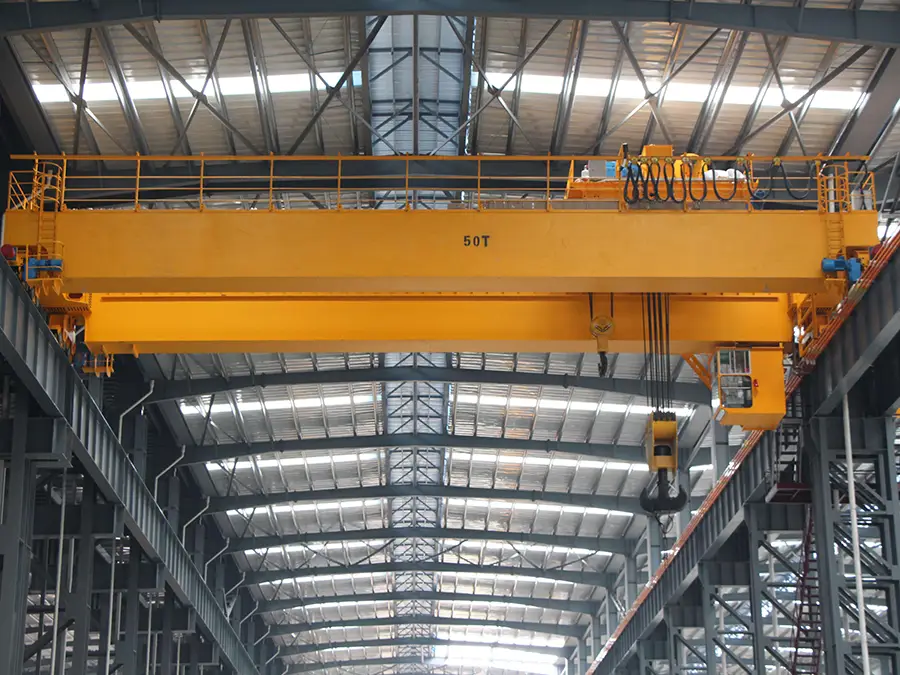
Lifting hooks may seem simple, but they are critical components in any lifting system. Because they bear enormous loads, their performance directly affects both the safety and efficiency of operations.Typically, hooks are often used in conjunction with accessories like pulley blocks and are suspended from the wire ropes of the hoisting structure, shouldering the responsibility of lifting a variety of heavy objects.
But not all lifting hooks are the same. They can be mainly divided into two types based on their manufacturing process: forged hooks and laminated hooks. Each type has its own advantages and uses.
So, which type is better for heavy-duty lifting? Let’s dive into their differences and find out which one suits your needs best!
What Is a Forged Hook?

Forged hooks are usually made from high-quality low-carbon steel or low-carbon alloy steel, such as #20 quality low-carbon steel, 16Mn, 20MnSi, or 36MnSi. These materials have good toughness and strength. They can resist impact and tension forces during lifting.
The forging process involves heating the chosen steel to a suitable temperature and then using large forging machines to hammer, shape, and stretch the steel. This process forms the rough shape of the hook. Forging removes internal air pockets and weak spots from the metal, making it more dense and stronger. After forging, the hook is slowly cooled in an annealing process to improve its stress resistance.
Forged hooks come in two forms: single hooks and double hooks. Single hooks are easier to make and use and are typically used for lighter loads (usually not exceeding 80 tons). Double hooks, which are also called “Ram’s horn” hooks because they look like a Ram’s horn, have a more balanced structure. They are used on cranes that lift heavier loads, commonly between 50 and 100 tons.
What Is a Laminated Hook?
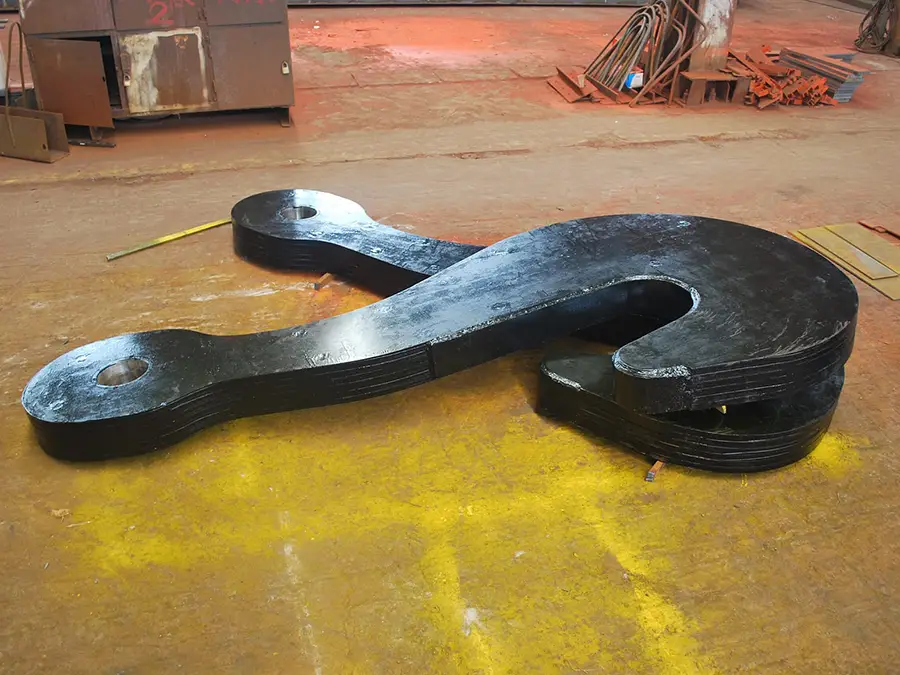
Laminated hooks, also known as built-up hooks, are made by stacking and welding or riveting multiple steel plates together. This layered structure enhances safety because a crack in one plate does not significantly affect the overall integrity of the hook, making failure less likely. Laminated hooks are also easier to inspect and repair. They are often chosen when cost control and ease of maintenance are key considerations.
However, due to their composite construction, laminated hooks are bulkier and heavier than forged hooks, and they typically offer lower overall strength.
Comparison Table: Forged Hooks vs. Laminated Hooks
| Comparison Item | Forged Hook | Laminated Hook |
| Strength & Toughness | Excellent strength and toughness. Uniform internal structure resists impact and heavy tension. | Good strength. Built from multiple plates, offering decent load-bearing but slightly less than forged. |
| Safety & Reliability | Highly reliable under heavy-duty, high-risk conditions. | High safety. Cracks in one plate don’t affect the entire hook, reducing risk of sudden failure. |
| Manufacturing Process | Forged from a single billet of steel at high temperatures and pressure. | Made by stacking and welding or riveting multiple steel plates together. |
| Inspection & Maintenance | Requires full replacement if damaged; less convenient for inspection. | Easier to inspect and repair; individual plates can be examined or replaced. |
| Weight & Size | Lighter and more compact for the same strength level. | Heavier and bulkier due to layered structure. |
| Cost | Higher cost due to complex forging process and material quality. | Moderate cost; more economical than forged hooks in certain applications. |
| Typical Applications | Ideal for critical lifting operations in ports, shipyards, mines, and heavy machinery. | Suitable for medium to heavy-duty work where forged hooks are not feasible or too costly. |
Tips: How to Tell the Difference Between Forged and Laminated Hooks
Appearance:
Forged hooks have smooth, continuous surfaces with minimal joints. Laminated hooks show visible layered lines or rivets due to their built-up design.
Structure & Complexity:
Forged hooks are one-piece and solid. Laminated hooks may appear more intricate due to their multi-plate composition.
Weight:
Laminated hooks are heavier for the same rated capacity, while forged hooks are lighter and more compact.

Best Choice for Heavy-Duty Lifting
For heavy-duty lifting work, forged hooks are clearly the better choice because of their excellent strength, toughness, and reliability. Forged hooks are more expensive due to their complex production process, but they offer superior performance and safety for critical lifting tasks. Laminated hooks, on the other hand, provide a cost-effective alternative with good safety and easier inspection, making them suitable for medium- to heavy-duty applications.
Choosing the right hook is like choosing the right shoes – it must fit your application. Always consider lifting intensity, load requirements, and the working environment to ensure safety and efficiency.
If you’re unsure which hook type best suits your needs, contact the GloryTrack technical team. We offer free expert consultations and product quotes based on years of industry experience and trusted test data.